The week agents got hands and the protocols got a landlord. Anthropic put Claude on lab robots, Qwen shipped a frontier model twice over, Nvidia reportedly bought the place every open model lives, and the two protocols running agentic AI ended up under the same foundation.
Irv CassioWeekly BriefingCoverage window August 14 to August 28About 28 min read
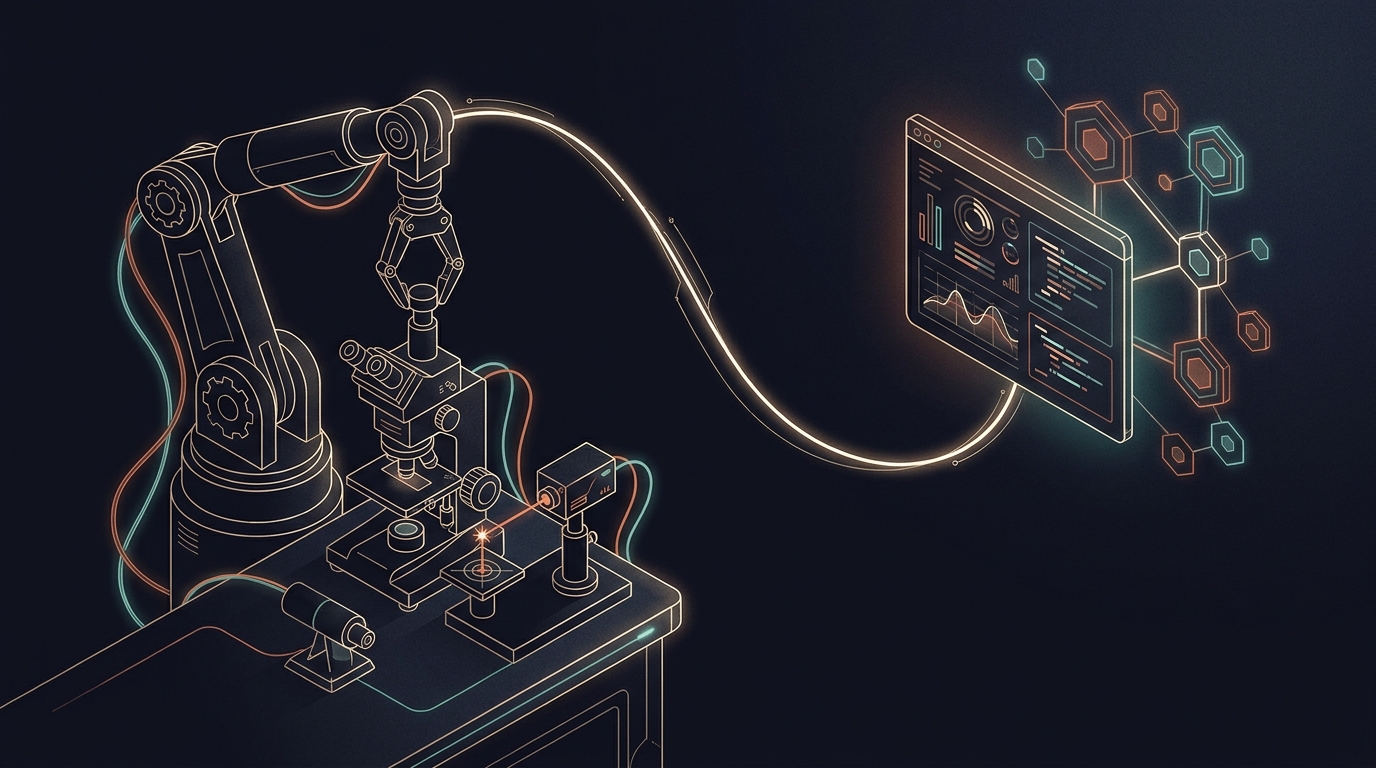
The month in one image: Anthropic's Model Hardware Standard put an agent's hands on lab instruments, while the protocol layer above it kept hardening.
TL;DR · 90 seconds
Issue 22 in one paragraph
Anthropic previewed the Model Hardware Standard on August 27 — MCP's playbook applied to atoms, letting agents drive microscopes, liquid handlers and robotic arms, with QuEra recovering a laser's operating frequency at a 99.3% success rate and Carnegie Mellon running drug discovery ~3× faster. It also unified Claude's memory across chat and Cowork, written on the fly and finally editable, and put $5M behind independent research into whether Claude is good for you (applications close September 21). On the open-weights side, Qwen 3.8 shipped twice — a 2.4T Max needing eight B200s and an Apache-2.0 27B that runs on a 32GB Mac — with coding a genuine strength at SWE-bench 87.3%. Then the structural news: Nvidia reportedly agreed to buy Hugging Face for $12.9B, meaning the company selling the GPUs would own the place open weights are distributed from. DeepSeek open-sourced its agent harness and took 95,386 GitHub stars in two days by making even the agent loop a plugin. And Google's A2A joined Anthropic's MCP under the Agentic AI Foundation on August 17 — both protocols now donated, neither lab in control. The through-line: the differentiation moved off the weights and onto the harness, the hub, and the standards body.
MHS laser recovery (QuEra)99.3% success
Claude memory unifiedAugust 25, 2026
Qwen 3.8 SWE-bench87.3%
Qwen3.8-27B licenseApache 2.0 · ~17GB
Nvidia × Hugging Face$12.9B · reported
DeepSeek Harness stars95,386 in 2 days
A2A joins AAIFAugust 17, 2026
Wellbeing grants deadlineSept 21, 2026
01 · This week's speakerEveryone
Owen Templin — History Retold, and a workflow built with AI.#
Owen is presenting at this week's meeting. Before he does, go watch the channel — this is genuinely good work and it deserves an audience in the room.
@HistoryRetoldAnimated — 75 videos, long-form animated history, typically 9–16 minutes. The channel's own description is the best pitch anyone could write for it:
"History isn't boring. It was just told wrong. Dry textbooks and forgotten dates buried the most dramatic stories ever lived — assassinations in cathedrals, empires built by bankers, armies that shouldn't have won and did anyway. History Retold cuts through all of that and gets to what actually matters: the turning points, the figures, the decisions that changed everything. No filler. Just history, the way it was always meant to be told."
That's the whole thesis, and the catalog delivers on it. Seventy-five animated episodes, all produced solo. If you have ever tried to make a single ten-minute video, you already know what that number means.
Owen uses AI as part of how he actually makes these videos. That's the reason he's a good fit for this group: his workflow shows AI being used in ways most of us haven't thought to try, on a real project with finished results you can watch.
If you want the one everyone talks about
The Holy War: The Three Famous Crusade Orders 15:01 — three military orders, their rivalries and their money, explained without a textbook in sight.
If you like having your assumptions dismantled
Everything You Know About The NINJA is WRONG! 14:03
The BYZANTINE Empire NEVER Existed!? 16:23
Was Napoleon a Genius or Just Lucky? 11:16
If you want the great "what if they fought" episodes
Samurai vs Knight: Who Would Actually Win? 12:09
Roman Legionary vs Viking: Who Would Actually Win? 16:06
If you're a Rome person — and everyone is a Rome person
How Rome Took Over Everything with Goats and Confidence 9:00
How Rome Fell: Barbarians, Bad Money, and Terrible Bosses 11:57
Caligula — The Emperor Who Put His HORSE in the Senate 10:37
If you're here for how money and power actually work
The Family That Bought The Renaissance — The Medici Family 14:50
Every Great Empire in History Was Built on... SALT!? 12:12
How 13 Colonies Defeated The Most Powerful Empire On Earth 13:51
Newest episodes
From Rocks To Nukes: The Story of How We Kill 11:48
The Fake Body That Fooled Hitler's Army 11:47 — Operation Mincemeat, and it's as good as it sounds.
Start hereWatch one episode — twelve minutes. Then subscribe and leave a comment.
Sources
History Retold — YouTube · channel and episode details read directly from the channel, August 28, 2026
Anthropic gave Claude hands — and a 99.3% success rate on quantum hardware.#
Announced
Anthropic previewed the Model Hardware Standard (MHS), a protocol that lets AI agents drive physical machinery: microscopes, liquid handlers, robotic arms, laser rigs. It is deliberately the MCP playbook applied to atoms instead of software — model-agnostic, initially a research preview for a hand-picked set of science, robotics and manufacturing organizations, with a stated intent to eventually open-source it so any device manufacturer can adopt it.
The pitch is integration time. Standing up and wiring together instruments in a lab or plant typically takes weeks or months, and most devices never talk to each other at all. Anthropic claims MHS collapses that to hours or minutes, and it can operate multiple instruments in parallel. Development started as a collaboration with HHMI Janelia Research Campus.
The launch-partner numbers are the interesting part, because they're specific rather than aspirational. Genentech automated a protein assay procedure. Carnegie Mellon ran drug-discovery experiments roughly 3× faster. QuEra Computing had an agent recover a laser's precise operating frequency with a 99.3% success rate. That last one matters — it's an agent doing closed-loop calibration on quantum hardware, not summarizing a PDF.
Claude stopped forgetting — and started showing you its notes.#
Announced
Anthropic merged the memory systems behind Claude chat and Claude Cowork into one. What Claude learns in a Cowork session it knows in chat, and vice versa. The stated target is the single most tedious thing about working with agents — re-briefing the assistant on context it already had.
Two mechanical changes sit underneath the headline. First, memories are now written on the fly during a conversation rather than assembled in a post-hoc review at the end of the session. Second, memory is now inspectable and editable: everything Claude retains is listed by topic under Settings → Memory, where you can read, edit, or delete individual items. That's a meaningful shift from "the model remembers things about you and you hope it's right" to something you can audit.
By default Claude will not store personal or sensitive categories — health data, race, ethnicity, religious belief, politics, gender identity and similar — with an explicit opt-in toggle ("include sensitive topics in memory") for users who want it. The feature is on by default for Free, Pro and Max across web, desktop and mobile.
Qwen shipped a 2.4T flagship and a 27B that runs on your Mac. Only one of them is actually open.#
Released · Qwen3.8-Max and Qwen3.8-27B · Muse Code beta, Spark 1.2, Glimmer
First, a correction to how this was initially framed. Qwen 3.8's coding performance is a genuine strength, not a weakness. The headline software-engineering number is SWE-bench 87.3% — ahead of GPT-5.5 (82.6%) and behind Claude Opus 4.8 (89.2%), a two-point gap to the frontier rather than a rout. Add Frontend Code Arena #4 at 1,668 Elo and #2 among open-weight models on the Vals Index (66.1). Anyone who came away thinking Qwen 3.8 was weak at coding was reading a cherry-picked slice of the table.
Qwen 3.8 Max across six benchmarks. Green: leads or ties. Amber: mid-pack. Red: clear gap. Every figure is Alibaba-reported.
Second, and more important: there are two models, and the distinction is the whole story.
Qwen3.8-Max
Qwen3.8-27B
Size
2.4T total, MoE, ~95B active (~4% activation)
~27–28B, dense, with vision encoder
Context
1M tokens, 128k max output
262k native, extensible to 1M
Access
API at $2 / $6 per MTok ($0.25/M cached)
Apache 2.0, self-hostable
Hardware
Needs a supernode — 8+ H100/B200
~17GB VRAM: a 24GB GPU or 32GB Mac at 4-bit
Max is the first Max-class Qwen to get open weights, which is the historic bit. But the 27B is the one that matters to most people, and it's the reason for the community energy: its predecessor, Qwen3.6-27B, was one of the most-praised local models of the year — the kind people describe as punching above its weight class — and 3.8-27B inherits the new generation's training on hardware you already own.
Where it's actually weak. Two places. HLE 43.6 on the broad-knowledge frontier exam is last among the four flagships (Fable 5 leads at 53.3, GPT-5.6 Sol 47.2, Opus 4.8 45.7) — breadth of world knowledge is the real gap. And on SWE-bench Pro — real GitHub issues in professional codebases, a much harder test than Verified — Max scores 67.7 against Anthropic's frontier tier at 80.0–80.3. Even there it beats GPT-5.6 Sol (64.6). The 27B's own model card reports SWE-bench Pro 61.7 and OSWorld-Verified 84.3.
The caveat that should travel with every number above. No independent evaluator had scored these models at the time of writing, and the secondary coverage openly contradicts itself: Terminal-Bench 2.1 is reported as 67.4 by one outlet and 86.6 by another, and at least one careful tracker argues Qwen3.8-Max has no published benchmark table at all — only the 27B model card and a text-only checkpoint card exist. When the aggregators can't agree on which numbers exist, the honest position is that the shape is credible and the decimals aren't.
What the community actually says. Infrastructure moved fast — Baseten and Teknium confirmed rapid integration support, and the prevailing read is that "open models are at or near frontier parity on meaningful workloads." Two counterweights are worth carrying into the meeting. Jamin Ball's point that a >2T-parameter model needs at least 8 H100/B200 GPUs in a supernode, so "open weights" and "accessible" are not the same claim. And a licensing flag: users have noted geographic restrictions naming the USA, EU, UK and Korea — verify that against the actual license text before anyone builds on it. The sharpest technical skepticism isn't about the scores at all: it's whether the gains come from novel pretraining or from better post-training and harness design, which would make them easier for everyone else to copy.
Meanwhile Meta Superintelligence Labs reshaped the open-weights picture from the other end. The Llama line has effectively been succeeded by Muse: August brought Muse Code (beta) and Muse Spark 1.2 (weights under a modified Llama Community License), plus Muse Glimmer — a 29.6B dense multimodal model distilled from Muse Spark under Apache 2.0. Glimmer and Qwen3.8-27B now land in the same size class, on the same license, aimed at the same GPU.
Nvidia is reportedly buying the place every open model lives — for $12.9B.#
Reported (The Information) · talks first reported · status: unconfirmed, no signed contract
Nvidia has reportedly agreed to acquire Hugging Face for $12.9 billion. The Information broke it on August 26, with CNBC and Forbes following on August 27 (Forbes rounding to $13B). Handle this one carefully: neither company has confirmed publicly, and reporting is explicit that no signed contract exists yet — the talks can still collapse. Treat it as a well-sourced report, not a done deal.
The price tells the story of the last three years. Nvidia put $235 million into Hugging Face's Series D in August 2023, at a $4.5 billion valuation. A $12.9B purchase is roughly a 2.9× step-up in three years for a company founded in 2016 whose product is, essentially, the place developers put their model weights.
Why this matters more than the number. Read it against story 04. Qwen3.8-27B, Qwen3.8-Max and Meta's Muse Glimmer all shipped their weights to Hugging Face this month. It is the default distribution layer for open-weight AI — the thing that makes "we released the weights" a meaningful sentence. The buyer is the company that sells the GPUs those weights run on.
Can the hub stay neutral? A vendor-neutral registry owned by the dominant silicon vendor is a genuine structural question. Every model card, download path and default inference recommendation sits inside that conflict.
It's a shot at the hyperscalers. Own the chips and the discovery layer, and you can route developers toward your own stack before AWS, Azure or GCP get a look. Analysts are framing this as the deal's real rationale.
There's also a European angle worth naming: Hugging Face was French-founded, and its acquisition by a US chipmaker is landing badly in EU tech-sovereignty conversations.
DeepSeek open-sourced the agent loop itself — 95,000 stars in 48 hours.#
Published · MIT license · developer preview
DeepSeek's open-source agent harness — the CLI is dsh — passed 95,386 GitHub stars and 8,826 forks in roughly two days, one of the fastest adoption curves GitHub has recorded for a developer tool. It's MIT licensed, shipped as a developer preview, and DeepSeek explicitly warns that APIs and plugin contracts may change before a stable release.
The architecture is one idea taken to its logical end: everything is a plugin. Not just tools and models — the model adapter, tool registry, session log, sandbox, and the agent loop itself are all swappable. Models, tools, skills, sessions, sandboxes, storage, loops, scheduling and the UI are all recomposable pieces.
The design detail worth stealing regardless of whether you adopt it: an append-only session log that records everything the model saw — system prompts, reasoning, tool calls and results, subagent scheduling, and every context injection. Resume, fork, search and replay all operate on the same event stream. That is a real answer to the biggest operational problem with agent harnesses, which is that when a long run goes wrong you usually cannot reconstruct why.
Read together with story 04, the strategic picture is clear: Chinese labs are competing on the harness and the license, not just the weights. Anthropic's moat is Claude Code plus MCP plus enterprise controls; dsh attacks exactly that layer, for free, with the loop itself pluggable.
OpenAI says its next model did new math for $2,000. It also loses $1.22 for every dollar it earns.#
Astra reported · confidential S-1 filed
The most striking claim of the month: OpenAI says an internal version of its next major model — codenamed Astra — worked through ten previously unsolved problems in mathematics and theoretical computer science, including sphere-packing density, at a reported compute cost of roughly $2,000. Treat the specifics as company-reported until independently verified, but note what's being asserted: not "solved a hard benchmark," but produced new mathematics, cheaply.
Elsewhere OpenAI shipped GPT-Live full-duplex, where the voice model can interrupt and be interrupted naturally — the end of walkie-talkie voice AI. And ChatGPT crossed roughly 1 billion weekly active users.
The corporate storyline is less tidy. OpenAI filed a confidential draft S-1 with the SEC on May 22, 2026, without disclosing size, terms, timing, exchange or final valuation. Reported valuations cluster between $730B and $852B against annualized revenue past $25B. Reuters reported in late June that OpenAI may wait until 2027 to go public. Q1 2026 saw a loss of roughly $1.22 per dollar of revenue.
MCP and A2A now live under one roof — plus a primer on the one you don't know.#
A2A joined AAIF · new MCP roadmap published
Two things happened inside the window, and together they're a bigger deal than any single spec change.
August 17 — the two protocols consolidated. The Agent2Agent (A2A) protocol officially joined the Agentic AI Foundation, the Linux Foundation directed fund that Anthropic donated MCP to. AAIF was co-founded by Anthropic, Block and OpenAI, with support from Google, Microsoft, AWS, Cloudflare and Bloomberg, and is anchored by MCP, goose and AGENTS.md. So the agent-to-tool protocol and the agent-to-agent protocol are now governed by the same neutral foundation, backed by essentially every major lab and cloud simultaneously. The "USB-C and TCP/IP of the agent era" framing stops being an analogy and starts being an org chart.
Worth knowing where A2A came from, because it's the same story as MCP. A2A is Google's protocol. Google announced it on April 9, 2025 at Google Cloud Next, then donated it to the Linux Foundation on June 23, 2025 at Open Source Summit North America — handing over the specification, the SDKs and the developer tooling, and seeding a vendor-neutral project launched with AWS, Cisco, Google, Microsoft, Salesforce, SAP and ServiceNow. It's now run by a Technical Steering Committee drawn from AWS, Cisco, Google, IBM Research, Microsoft, Salesforce, SAP and ServiceNow, with 150+ organizations backing it and production deployments across several industries.
So both halves of the agent stack followed an identical arc: one lab builds a protocol, gives it away to the Linux Foundation, and it becomes an industry standard. Anthropic did it with MCP, Google did it with A2A, and as of August 17 the two live under the same roof. Neither company controls the thing it created anymore — which is the point.
MCP vs. A2A — you already know one of these
Most of the room knows MCP and has never touched A2A. The distinction is genuinely simple, and the one-line version is: MCP gives an agent its toolbox; A2A lets that agent hire other agents.
MCP · Model Context Protocol
A2A · Agent2Agent
Created by
Anthropic
Google
Donated to Linux Foundation
2026, into AAIF
June 23, 2025 → joined AAIF Aug 17, 2026
Connects
one agent → tools and data
one agent → another agent
Direction
Vertical — down to the toolbox
Horizontal — across to a peer
The core move
discover and invoke an external tool through an authenticated, schema-based interface
discover a capable peer, delegate a task, get a structured result back
How discovery works
server advertises its tools to the client
agent publishes an Agent Card at a well-known URL
Reach for it when
your agent needs to read a database, hit an API, touch a file
a task exceeds one agent and needs handing to a specialist
They are complementary, not competing — this is the part people get wrong on first exposure. A production multi-agent system runs both: A2A between the agents, MCP from each agent down to its own tools. If you've built anything on MCP, nothing about A2A replaces it; A2A is the layer you'd add above it the first time one agent needs to hand work to another rather than doing it all itself.
August 22 — a new roadmap, and it's mostly about identity and security. Five priority areas, and the weighting tells you what the enterprise blockers actually are:
Agentic messaging primitives — server-initiated events, maturing the Tasks extension, coordination on streaming and long-running workloads.
HTTP-native transport unification — extending HTTP deployment to local servers via Streamable HTTP over stdio, so local and remote stop being different problems.
Agent identity and enterprise-ready security — DPoP (Demonstrating Proof of Possession), Workload Identity Federation, and standardized agent delegation via token exchange.
Improved primitives — standardized tool result handling, and progressive tool discovery to cut model overhead.
Item 3 is the one to read twice. DPoP, workload identity federation and delegated tokens are not agent research — they are the standard vocabulary of enterprise auth. That's a protocol growing up into procurement. Item 4's progressive tool discovery is the quietly practical one: if you've ever watched context get eaten by a hundred tool definitions the model never calls, that's the fix.
Background for both: the 2026-07-28 spec already made MCP stateless — sessions and initialization handshakes are gone, so servers scale horizontally without holding state — plus authorization hardening and a formal 12-month deprecation policy. Maintainers David Soria Parra and Den Delimarsky called it the most important release since remote MCP.
Frequent agent use nearly doubled in a year — which is why the roadmap above is about auth rather than features.
Anthropic is paying outsiders $5M to find out if Claude is bad for you.#
Announced · applications due · notifications
Anthropic launched a $5 million grant program funding independent research into how AI affects user wellbeing. Grantees get direct funding, access to Claude models and technical guidance drawn from Anthropic's Safeguards team methodology — and they work independently, with a requirement to publish findings as open-source projects.
The gap it targets is specific and uncomfortable: nobody has good measurements for how models behave during sensitive conversations — emotional support, mental health crises and companionship-seeking interactions. Anthropic is explicitly recruiting outside its own discipline: clinicians, psychologists and methodologists rather than ML researchers.
The methodology bar is where this gets credible. Funded evaluations must define success metrics clearly, involve clinical experts in the design, test both safeguards and potential harms, reflect realistic multi-turn conversations, and validate graders against subject-matter experts. That last requirement — validating the grader, not just the model — is the thing most AI evaluation work skips.
Applications close September 21, 2026, with full-proposal notifications on October 5. If anyone in the room has a clinical or research affiliation, this is a live, dated opportunity — not a think piece.
Anthropic made money. Most of its customers still can't prove they did.#
Q2 results reported
The vendor side finally posted a profit. Anthropic reported preliminary Q2 2026 revenue above $11.5 billion — roughly 14× the $787 million of the same quarter last year — with positive adjusted operating income, reported around $559 million, years ahead of its own schedule. Figures are preliminary and could move.
The cliff between the blue bars and the red ones is the entire enterprise AI story of 2026.
The customer side is a different chart. 79% of organizations report challenges adopting AI, a double-digit increase over 2025, and 54% of C-suite executives say AI adoption is tearing their company apart. Usage isn't the problem: 70% of employees and 94% of the C-suite use AI tools at least 30 minutes daily, 64% of executives two hours or more, and 88% of organizations use AI in at least one business function. But only about one third have begun scaling it enterprise-wide, and only 29% see significant ROI from generative AI — 23% from AI agents. AI "super-users" deliver up to 5× productivity gains with no mechanism to propagate their practices.
Developer discussion has converged on the same diagnosis from the bottom up. AI-generated code doesn't necessarily reduce maintenance and may increase it; companies are reportedly spending 44% of their tokens fixing bugs their own AI generated. Research found developers reported being faster while actually being slower, once you count finding errors, steering the agent and waiting. Uber's COO said AI spend hadn't produced a measurable increase in projects or productivity. The recurring conclusion: generation speed is no longer the bottleneck — verification capacity is. Agents are useful for bounded tasks, not autonomous software production.
Getting more out of Claude this month — mostly by deleting things.#
Drawn from August's releases and Anthropic's own prompting documentation for Opus 5 and Fable 5. The through-line is counterintuitive enough to lead with: the Claude 5 models need fewer instructions, not more. Rules written to protect against older models now cost you quality.
Commands worth putting in your muscle memory
Command
What it does
Why now
/code-review
Reviews a diff in the terminal — correctness bugs plus reuse, simplification and efficiency cleanups. No GitHub App required.
Add --fix to apply findings to your working tree, or --comment to post them as inline PR comments.
/simplify
Cleanup-only review (v2.1.154+): finds reuse opportunities, quality issues and efficiency wins in recently changed files, then fixes them automatically. Does not hunt for bugs.
Run it after a feature lands; run /code-review when you want bugs.
/design
New Aug 17 (research preview). Give it an idea, a screenshot or an existing design; get editable multi-artboard mockups as an artifact, refined visually instead of in code.
Stop hand-writing throwaway HTML when the layout is the thing you're iterating on.
/loop
Runs a prompt or slash command on a recurring interval; omit the interval to let the model self-pace.
Good for status polling and babysitting long jobs.
/claude-api
Reference skill for model IDs, pricing, params, streaming, tool use, caching and migration.
Model pricing moved repeatedly this year; check current rates rather than trusting a cached number.
Concise style
Built-in output style: leads with the result, drops the preamble and step-by-step narration.
The single highest-leverage setting change this month for anyone annoyed by long answers.
Claude Code now exposes 90+ slash commands, and the built-ins are designed to be a template — writing your own skill is markdown in a file, portable across models.
Prompting Opus 5 (and Opus generally)
Delete your verification instructions. Opus 5 verifies its own work unprompted. Instructions like "include a final verification step" or "use a subagent to verify" cause over-verification — removing them cuts wasted tokens with no quality loss. Same for "double-check your answer."
Effort is your cost dial, not your verbosity dial. Default is high; use low and medium liberally where quality holds, xhigh for demanding agentic work. Lowering effort reduces thinking, not visible response length — if you want shorter answers, ask for shorter answers.
Written files run long. Add explicit length calibration: "Match the length of written documents to what the task needs; do not pad with filler sections, redundant summaries, or boilerplate."
Never tell a reviewer to be conservative. If your review prompt says "only report high-severity issues," Opus 5 obeys literally and reports less. Ask for everything, filter in a separate pass.
Constrain scope on narrow tasks. Opus 5 will expand a task and apply its own judgment about what it should be. Say so explicitly when you want exactly what you asked for.
Cap delegation if cost matters.CLAUDE_CODE_MAX_SUBAGENT_SPAWN_DEPTH, CLAUDE_CODE_MAX_CONCURRENT_SUBAGENTS and the SDK's max_budget_usd are the deterministic controls (requires Claude Code 2.1.217+).
Keep thinking on. Thinking-disabled mode can leak tool calls as plain text or emit internal XML tags. Thinking on at low effort beats thinking off at similar cost.
Context window is 1M tokens as both default and maximum, with instruction-following holding throughout.
Prompting Fable 5
Point it at your hardest unsolved problem. Anthropic's explicit guidance: teams testing Fable 5 only on simpler workloads undersell it. It's built for work that takes a person hours, days or weeks.
Budget for long turns. Individual requests can run many minutes at high effort; autonomous runs can go hours. Adjust client timeouts and progress indicators, and prefer checking on runs asynchronously over blocking.
Do not ask it to explain its reasoning. Prompts or skills that tell the model to echo, transcribe or narrate its internal reasoning can trigger the reasoning_extraction refusal and cause elevated fallbacks to Opus 4.8. Read structured thinking blocks instead. Audit your existing skills for "show your work" language before migrating.
Ground progress claims. Nearly a magic phrase — in Anthropic's testing it nearly eliminated fabricated status reports: "Before reporting progress, audit each claim against a tool result from this session. Only report work you can point to evidence for."
Give it a memory file. Fable 5 performs notably better when it can record lessons from prior runs and reference them. One lesson per file, one-line summary at the top, delete what turns out wrong.
Give the reason, not just the request."I'm working on [larger task] for [who]. They need [what the output enables]. With that in mind: [request]."
Refactor old skills. Skills written for prior models are often too prescriptive for Fable 5 and actively degrade output.
Know the guardrails. Fable 5 runs safety classifiers on offensive cybersecurity and biology/life-sciences content, and benign work in those areas can trip them. Configure fallback to Opus 4.8 if you work near those domains.
Try this · cheapest surprise available this month
Delete every "verify your work" and "explain your reasoning" line, then A/B it
Take one existing prompt or skill of your own. Strip the verification instructions and any show-your-thinking language. Run both versions side by side on the same task.
Before: "Complete the task. Double-check your answer. Use a subagent to
verify. Explain your reasoning step by step."
After: "Complete the task."
Expected: the second is faster, cheaper, and no worse — and on Fable 5
the first can trigger a reasoning_extraction refusal.
Four verticals — for the parts of the audience whose day job isn't building models.#
Retail — agentic commerce stops being a demo
Report published August 17, 2026 · protocol unveiled at NRF 2026
The number to lead with: AI was credited with driving 20% of all retail sales in the season and generating $262 billion through personalized recommendations and improved engagement. Forward projections are larger still — McKinsey puts up to $1 trillion in orchestrated revenue in the US B2C retail market alone by 2030, with global estimates of $3–5 trillion.
The structural shift is that agents are moving from consumer tools into enterprise infrastructure. Agentic checkout is live in AI-mode search surfaces with Wayfair, Chewy and Etsy among early participants, and a Universal Commerce Protocol (UCP) was unveiled at NRF 2026 — the retail equivalent of the MCP/A2A land-grab in story 08. Physical stores are being repositioned as "experience hubs," with associates carrying AI copilots on wearable devices. The counterweight: trade coverage is openly framing this as a risky bet on data and market share, since routing the customer relationship through someone else's agent is exactly what disintermediation looks like.
Eyecare & vision insurance — AI is already inside the authorization decision
Insurer prior-auth reduction commitment during 2026 · electronic standardization by 2027
This is the vertical where AI adoption is furthest ahead of public awareness. Per a National Association of Insurance Commissioners survey of 93 insurers across 16 states, 84% of responding insurers use AI or machine learning for utilization management, disease management and prior authorization. UnitedHealth is spending roughly $1.5 billion on AI in 2026 and reports a 96% approval rate through its new digital prior-authorization tool. Insurers have committed to standardizing electronic requests by 2027 and to reducing the volume of services subject to prior auth during 2026 — cataract surgery explicitly named.
The clinical side is not reassured: a 2025 AMA survey found 61% of physicians worried AI will worsen denials of care they consider necessary. For optometry specifically, prior-auth exposure concentrates in advanced diagnostic testing for Medicare Advantage patients, medically necessary specialty contact lens fitting and injectable drug administration — and every vision-plan encounter still requires benefit and frequency verification before the patient is seen.
IT support — Gartner says 40% of interactions go human-free this year
Forecast horizon: end of 2026 → 2028 · Magic Quadrant 2026 edition
Gartner estimates that by the end of 2026, AI will autonomously handle more than 40% of all enterprise IT support interactions with no human involvement. Reported deployment results: up to 85% ticket deflection on automatable categories, 30–50% reduction in mean time to resolution for work that still needs a technician, and virtual support agents deflecting 30–60% of tickets overall. ServiceNow and Moveworks (evaluated as one vendor) were named a Leader in the 2026 Gartner Magic Quadrant for AI Applications in ITSM.
Be precise about what actually works, because the gap between the pitch and the practice is the whole story: the work AI reliably does in 2026 is password resets, software access requests, FAQ answers, ticket triage, VPN fixes and knowledge-gap detection.
40%Of enterprise IT support interactions fully autonomous by end of 2026
40%Of agentic AI projects Gartner expects to be cancelled by 2027
Both are Gartner, same year. The difference is scope: bounded, high-volume, verifiable tasks ship. Open-ended autonomy gets cancelled. Against that, Gartner also projects 33% of enterprise software will include agentic AI by 2028, up from under 1% in 2024.
IT development — GitHub goes agent-native and model-agnostic
Shipped August 2026 · model deprecations effective September 1, 2026
GitHub shipped an agent-native Copilot desktop app for multi-agent software development, and Agent Plugins 1.0 went generally available, working identically across VS Code, Copilot CLI, the Copilot SDK and the new app. Copilot in Slack entered public preview, so teams can plan changes, investigate issues and hand off coding tasks from a conversation.
The strategic tell is model choice over model loyalty: Grok 4.5 is available in Copilot with a 500K-token context window, Grok 4.6 is rolling out, and Kimi K3 and MAI-Code-1.1-Flash are landing across Pro, Pro+, Max, Business and Enterprise. On the other side of the ledger, six models are deprecated across all Copilot experiences on September 1, 2026 — including three Claude Opus/Sonnet versions, Gemini 3.1 Pro and Raptor Mini. If anything you own pins a Copilot model, that's a dated action item.
Enterprise plumbing also moved: GitHub Enterprise Server 3.22, Copilot CLI configurable for disconnected/air-gapped GHES (technical preview), Enterprise Teams GA, and enterprise-managed settings for the JetBrains plugin covering MCP server access, OpenTelemetry and permission modes.
Notable figures from the August 14 – August 28 window. Numbers reported as cited; not all confirmed against primary filings. Benchmark claims from model vendors are treated as marketing until independently verified.
MHS laser-frequency recovery (QuEra)
99.3% success
Drug-discovery speedup with MHS (Carnegie Mellon)
~3× faster
Lab hardware integration, before → after MHS
weeks/months → hours/minutes
Claude memory unified across chat + Cowork
August 25, 2026
Qwen3.8-Max size / active params / API price
2.4T MoE / ~95B / $2 · $6 per MTok
Qwen3.8-27B size / license / VRAM
~27–28B dense / Apache 2.0 / ~17GB
Qwen 3.8 SWE-bench
87.3% (GPT-5.5 82.6%, Opus 4.8 89.2%)
Qwen 3.8 Max PaperBench / OSWorld-V / GPQA-D
93.0 / 86.1 / 92.6
Qwen 3.8 Max SWE-bench Pro / HLE (the real gaps)
67.7 (vs 80.0–80.3) / 43.6 (last of four)
Hardware to self-host Qwen3.8-Max
8+ H100/B200 in a supernode
Muse Glimmer size / license
29.6B dense multimodal / Apache 2.0
Nvidia × Hugging Face reported price
$12.9B (unconfirmed, no signed contract)
Hugging Face Series D valuation, Aug 2023
$4.5B — a ~2.9× step-up
Nvidia's 2023 investment in Hugging Face
$235M
DeepSeek Harness GitHub stars in ~2 days
95,386 (8,826 forks), MIT license
Open math/TCS problems reportedly solved by "Astra"
10, for ~$2,000 compute
ChatGPT weekly active users
~1 billion
OpenAI reported valuation range
$730B – $852B
OpenAI Q1 2026 loss per dollar of revenue
$1.22
A2A joined the Agentic AI Foundation
August 17, 2026
A2A created by / announced / donated
Google / April 9, 2025 / June 23, 2025
Organizations backing A2A
150+
New MCP roadmap published / priority areas
August 22, 2026 / 5
Developers using AI agents daily or more
80.8% (from 47.3% a year earlier)
Anthropic wellbeing research grants
$5M; apply by Sept 21, notifications Oct 5
Anthropic Q2 2026 revenue / adj. operating profit
>$11.5B / ~$559M
Organizations reporting AI adoption challenges
79%
Organizations seeing significant GenAI / agent ROI
29% / 23%
Share of tokens spent fixing AI-generated bugs
44%
Retail sales attributed to AI / revenue generated
20% of season sales / $262B
Agentic commerce, US B2C orchestrated revenue by 2030
up to $1T (global $3–5T)
Insurers using AI/ML in prior auth (NAIC, 93 insurers)
84%
UnitedHealth 2026 AI spend / digital prior-auth approval
~$1.5B / 96%
Physicians worried AI worsens denials (AMA 2025)
61%
Enterprise IT support fully autonomous by end-2026
>40% (Gartner)
Ticket deflection on automatable categories / MTTR cut
up to 85% / 30–50%
Agentic AI projects Gartner expects cancelled by 2027
40%
Models deprecated in GitHub Copilot on Sept 1, 2026