Issue No. 32 · The New Lineup Edition · Weekly Briefing
32The AI Enthusiast November 13 · 2026
The New Lineup Edition:which AI for which job.
Four new models in four days, a secret-stealer loose on GitHub, and the week Nvidia lost its founder.
In four days, Anthropic, Google and Meta each shipped a new model: a new top model that costs less, a fast default for Google Search, and a model cheap enough to run all day. Our feature sorts out which one to use for which job. Around it, the AI economy had its strangest week of the year. Nvidia lost its founder, Anthropic set a price range for an IPO that could raise $64 billion and said AI is now speeding up its own research, and a campaign called wfx used thousands of hijacked GitHub accounts to steal the keys that run your AI tools.
Irv CassioCoverage window November 5 to November 13About 75 min read
Cover illustration: drawn in SVG for The AI Enthusiast
TL;DR · 30 seconds
Issue 32 in six lines
Feature:Claude Fable 5.2 is the new top model at $8/$40, Gemini 4 Hydrogen now runs Google Search, and Muse Ember costs $0.10. Which one for which job, and a five-minute bake-off.
Security check: a campaign called wfx used 4,837 hijacked GitHub accounts to steal CI secrets and AI keys. Three checks, three minutes.
Anthropic: an IPO of up to $64.35B at $70–78 a share, ticker ANT, and a filing that says AI is now speeding up its own research.
Nvidia:Jensen Huang resigned after a week of scandal, five days before earnings.
GitHub, beyond Copilot: a new Git storage system built for 5,000 agents on one repository, sessions that follow you, a Copilot that remembers, plus CodeQL and Spec Kit. What's live and what's preview.
$8 / $40Claude Fable 5.2 per million tokens, in/out (was $10/$50)
4,837Hijacked GitHub accounts in the wfx campaign (Aikido)
$64.35BAnthropic's maximum IPO raise (CNBC)
$740B+Nvidia value lost, previous Friday to Nov 11 (CNBC)
1.9%AI agent store visits that reach checkout (HUMAN)
01
01 · Feature · New modelsAll users · Power users · Developers
Four new models in four days. Which AI to use for which job, now that the top model got cheaper and the fast ones got smart.#
– · Claude Fable 5.2 and Muse Ember · Gemini 4 Carbon wider · Qwen4-Max-Preview · Gemini 4 Hydrogen and Anthropic's "daily driver" advice
Most people pick one AI model and never change it. This week is a good reason to look again. Three companies shipped models that change the trade-off between quality, speed and cost: Anthropic's new top model got cheaper, Google's fast model now answers Google Search, and Meta shipped one cheap enough to run all day.
Claude Fable 5.2 launched November 9 at $8/$40 per million tokens. Image: Anthropic.
Why it mattersFor two years the best model was also the most expensive one, and most people couldn't afford to use it all day. This week the top model got cheaper, the fast models got close enough for most work, and the cheapest one got a 1M-token memory. The right answer for most people is still the boring one: a good daily driver, plus a top model for the hard jobs.
At a glance · the new lineup
Top model
Claude Fable 5.2: $8/$40, #1 on Artificial Analysis at 65, 55% fewer blocked requests
Fast default
Gemini 4 Hydrogen: $1.50/$7.50, now powering Google Search for everyone
Cheapest
Muse Ember: $0.10/$0.50 with a 1M-token context
Price cliff
Gemini 4 Carbon doubles to $4/$20 after November 30
Free trial
Claude Pro gets extra Fable usage through November 16
Anthropic's advice
Keep Opus 5.5 at Medium as your daily driver
What shipped
Claude Fable 5.2 (Anthropic, November 9). Anthropic's new top model, with a twin, Mythos 5.2, that only verified cyber and life-sciences organizations can use. It costs $8 per million input tokens and $40 per million output tokens, down from $10/$50 for the 5.1 models. Fast mode costs $16/$80 for up to 2.5x faster output. It has a 1M-token context and 128K maximum output, and thinking is always on. On Anthropic's own benchmarks it leads FrontierSWE v2 (69.9%, against 62.3% for Opus 5.5 and 65.5% for GPT-6 Astra) and more than doubles Fable 5.1 on the Remote Labor Index (41.3% vs 17.9%) (self-reported). Independent tests agree it's at the top: Artificial Analysis ranks it #1 at 65, ahead of Gemini 4 Carbon (60), Opus 5.5 (59) and GPT-6 Astra (57), per Latent Space. It also refuses less: Fable 5.2 blocks about 55% fewer requests than Fable 5.1 (about 60% fewer in cyber and 40% fewer in bio), and blocked cyber or bio questions fall back to an older model instead of a flat no.
Gemini 4 Hydrogen (Google, November 12). Google's new fast "daily driver," now powering Google Search for all users and available in the Gemini app, the API, Sheets and Antigravity. It costs $1.50/$7.50 across its full 1M-token context. Google says it's 2.5x faster than Gemini 3.8 Flash with more than 5x fewer made-up claims (self-reported), and it adds an "xhigh" thinking level. Google's own charts show it behind rivals on science, maths, computer use and Terminal-Bench 4.1. (Not to be confused with Hydrogen-1.0, a different model in Issue 31.)
Muse Ember (Meta, November 9). Meta Superintelligence Labs' cheapest model, built for high-volume agent subtasks: routing, tool calls, extraction, parsing long documents. It costs $0.10/$0.50 for prompts up to 200K tokens ($0.30/$1.50 above that) with a 1M-token context and 512K maximum output. Meta says it matches Claude Haiku 5.5 on the Artificial Analysis index at about a third of the price (self-reported). It's offered through Meta's API; we found no release of its weights. More in story 15.
Gemini 4 Carbon, wider (November 10).Issue 30 covered Carbon's announcement. It's now on paid Gemini API plans and for Google AI Ultra subscribers in the Gemini app, Antigravity and AI Mode in Search. The introductory price of $2/$10 rises to $4/$20 after November 30. It's also in GitHub Copilot from November 10 (story 06).
Qwen4-Max-Preview (Alibaba, November 11). A cloud-only preview with no downloadable weights, open November 11–25. It was a quiet week for open-weight models (see Also worth a mention).
Gemini 4 Hydrogen now powers Google Search (November 12). Image: Google.
And one piece of advice from Anthropic itself (November 12): use Opus 5.5 at Medium effort as the daily driver, move to High when Medium stalls, and switch models only after you've given full context and tried more effort. Save Fable 5.2 for "the most demanding, long-running or open-ended" work.
What the output costs
Vendor API list prices, checked November 13. A cheaper price per token isn't a cheaper job: see the risks table below. Chart: The AI Enthusiast.
How to choose
Running the same job thousands of times a day in an app? Price the output tokens first. Diagram: The AI Enthusiast.
The new lineup (checked November 13)
Prices are per million tokens, input/output, on the vendors' APIs. Rows marked background didn't change this week; they're here for comparison.
This week's new AI models compared: maker, release date, price, context, best use and who gets them
Model
Maker
Released
Price (in / out)
Context
Best for
Who gets it in the app
Claude Fable 5.2
Anthropic
Nov 9
$8 / $40 (fast: $16 / $80)
1M
Hardest coding, research, long agent runs
All paid Claude plans; Pro and standard Team seats get it for up to 50% of weekly limits through Nov 16, then usage credits
Claude Opus 5.5
Anthropic
Background
Unchanged
—
Anthropic's recommended daily driver
All paid Claude plans
Gemini 4 Hydrogen
Google
Nov 12
$1.50 / $7.50
1M
Fast everyday work, coding and agents
Google Search for everyone; Gemini app model picker (free users through auto selection); Sheets on AI Pro/Ultra
Meta Model API and Muse Code (also Google Cloud and Oracle Cloud); no weights release found
Qwen4-Max-Preview
Alibaba
Nov 11
Token Plan only
1M
Trying Alibaba's next flagship
Alibaba Cloud only, until Nov 25
Muse Ember costs $0.10 per million input tokens (November 9). Image: Meta via TechCrunch.
The Fable 5.2 launch offer, in plain terms
Pro and standard Team seats can use Fable models for up to 50% of weekly limits through November 16, 11:59 PM PT, plus one Fable limit reset that expires the same day. After that, Fable usage draws on usage credits if you've turned them on. Max, Ultra and premium seats get one to three Fable resets, depending on how long they've subscribed (under 6 months: one; 6–12 months: two; over 12 months: three). These resets last until March 8, 2027. Use one from Settings › Usage › Limit resets › "Reset for free." Billing had to be in place before November 9, 10:00 AM PT. In Claude Code, saved Fable 5.1 choices move to 5.2 automatically on Pro and Max; /model claude-fable-5-1 switches back. (Claude Help Center.)
A five-minute starter: run your own bake-off
Benchmarks are averages; your work isn't. Pick one real task you do every week and run the same prompt through two models, your daily driver and one of this week's new ones:
Here's a real task from my week: [paste the email thread, report or data].
Do it as if you were me, and finish it. Then tell me in two lines what you
assumed and what you'd need from me to do it better.
Then compare: Was it right? Did it finish, or stop at an outline? How long did it take? If the new model isn't clearly better, stay where you are.
Three gotchas from Anthropic's November 9 release notes. The preserved-thinking prefix check now applies to every account on 5.2: edit the system prompt, tools or an earlier message, then send back a later 5.2 thinking block, and you get a 400 error. Computer use now needs the computer_toolset_20260801 toolset; the old computer_20251124 tool returns a 400 everywhere except Bedrock. And 5.2's thinking blocks can't be read by other models, so they're dropped if you switch away mid-conversation.
Risks and controls
Risks of switching to this week's models and the controls for each
Risk
What we know
Control
A cheaper price doesn't mean a cheaper job
SemiAnalysis ranks Fable 5.2 #1 on its GDPx test, but its cost per task rose from $67.16 to $88.15, because it works longer
Measure cost per finished task, not price per token; keep Opus 5.5 or a small model as the default
Data retention
Fable and Mythos 5.2 require 30-day retention; no zero-data-retention without Anthropic's express OK. In GitHub Copilot, Fable 5.2 "requires data retention by default," and Business/Enterprise admins must switch it on
Check your organization's retention policy before routing sensitive work to it
Price cliffs
Gemini 4 Carbon doubles to $4/$20 after November 30; Pro's extra Fable usage ends November 16
Put the dates in your calendar; don't build a workflow around a promo price
Self-reported benchmarks
Most launch numbers come from the vendors. Google's own charts show Hydrogen behind on science and computer use
Trust your own bake-off over a leaderboard
Lower refusal rates
Fable 5.2 blocks 55% fewer queries. Anthropic says its sandbox-escape tests improved (Mythos 5.2 used out-of-sandbox credentials in 3.1% of scenarios, vs 21% for Mythos 5.1)
Keep permission prompts and human review on anything that touches production or money
Outages at launch
Claude's status page logged errors on Fable/Mythos 5.2 on November 10 and broader errors on November 13
Have a fallback model set in tools that support one
A price range for a $64 billion IPO, and an admission: AI is now speeding up its own research.#
– · follow-up to Issue 31
Issue 31 covered Anthropic's first amended S-1 (November 2): a $17 billion quarter, $895 billion in commitments, and a warning that it "may imminently meet" its own threshold for AI-accelerated research. This week it set a price range, launched the roadshow, and said the threshold has been met.
Anthropic launched its IPO roadshow on November 10. Image: Anthropic.
The offer (November 10)
Anthropic filed a second amended S-1 and launched its roadshow. It's offering 825,000,000 Class A shares (801.4M new shares from Anthropic and 23.6M from existing holders) at $70 to $78, on the Nasdaq under the ticker ANT. Underwriters have an option on another 123.75M shares. Goldman Sachs and Morgan Stanley lead. Separately, AMD, Broadcom, Google, Micron, Microsoft, NVIDIA and TSMC agreed to buy $26 billion of non-voting shares at the IPO price, closing right after it.
What CNBC's sources add
Pricing is set for November 18 and trading for November 19. At the top of the range the IPO would raise up to $64.35 billion and value Anthropic at up to $1.405 trillion fully diluted, against $965 billion in its May funding round. The order book was already covered, and about 20% of shares are set aside for individual investors, against a typical 5–10%.
Everyone who owns our stock, whether an institution or an individual, becomes part of that effort.Anthropic's co-founders, in the prospectus · November 10, 2026
The threshold
New text in the filing: "Because the AI research and development capability threshold under our Responsible Scaling Policy applies where we 'observe or expect' a specified degree of accelerated progress, we made a determination that we have met this threshold based on what we expect from future models and our overall rate of progress, rather than on what we have observed from current models. We continue to assess the underlying data." Anthropic says it will "release further reports in the future."
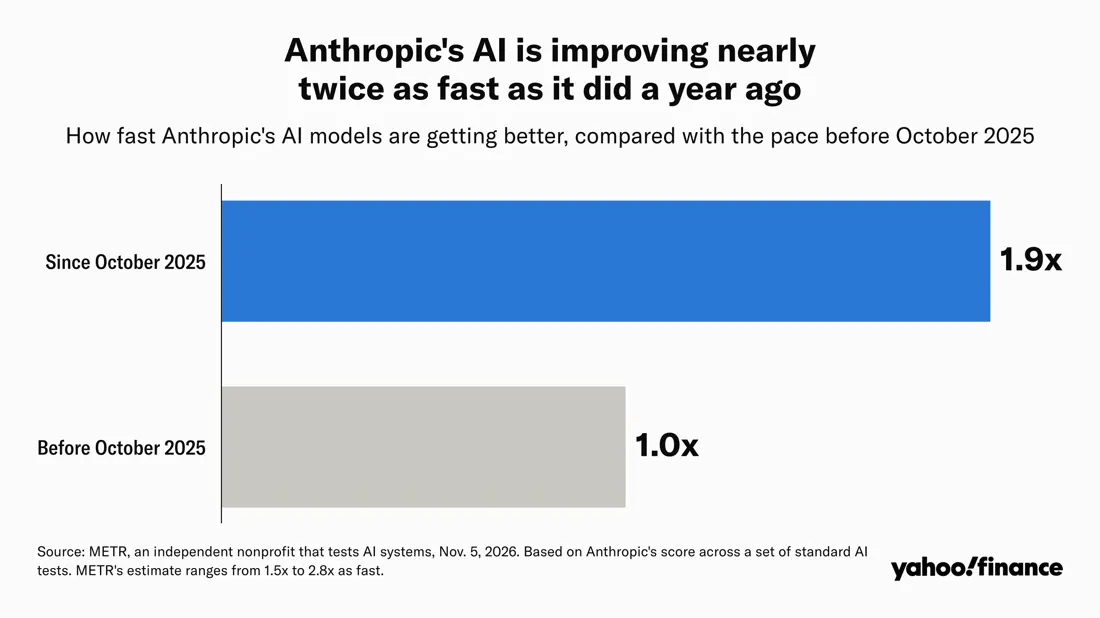
In plain terms, the threshold is about AI doing enough of Anthropic's own research to roughly double the pace of progress. Meeting it means more safeguards, not a pause (Yahoo Finance). The Fable 5.2 launch page says Anthropic deliberately held some of the model's AI-research abilities back in training, to about Opus 5.5's level.
METR estimates Anthropic's models are improving about 1.9x faster than before October 2025. Image: Yahoo Finance, using METR data.
Settled from Issue 31
Outlets reported Anthropic's Q3 operating loss as either $536M or $567M. The new filing says $567 million, against a $974 million operating profit in Q2. Q3 revenue was $17.0 billion, nine-month revenue $33.2 billion, and Anthropic had about 5,300 employees on September 30. The filing also says a large compute deal with Lambda is "currently terminable by either party," though neither side has given notice and Anthropic doesn't intend to end it.
Worth watching: how LLMs are trained
One long video from the same week, picked by the author as worth the time. Matthew Berman interviews a guest named Jeremy (the description links x.com/jeremyberman) in a conversation titled "Anthropic Researcher explains how to train LLMs" (published November 12, 56 minutes). The link below opens at 32:32, where the author suggests starting. We couldn't read a transcript, so this entry doesn't summarize the talk, and we couldn't independently confirm the guest's role at Anthropic from the video page.
Why it mattersAt up to $64 billion, the offering is huge, and with a fifth of shares set aside for individuals, many readers may soon own a piece of an AI lab directly or through their funds. Anthropic is also the first lab to tell investors, in a legal filing, that its AI is now measurably speeding up its own work. Anthropic says it's adding controls; the IPO means public shareholders now have a stake in how fast it goes.
Jensen Huang is out. The founder of the company that sells AI its chips resigned after a week of scandal, five days before earnings.#
–
On Thursday, November 12, Nvidia said Jensen Huang had resigned as president, CEO and board member, effective immediately. CFO Colette Kress is interim CEO while staying CFO, and the board is looking at internal and external candidates. Former Synopsys CEO Harvey C. Jones became Nvidia's first-ever board chair. "The Board has full confidence in Colette and the leadership team," Jones said. Nvidia gave no reason. A spokesperson later said Huang won't work with Nvidia in any capacity.
Jensen Huang resigned as Nvidia's CEO on November 12. Image: Sean Rayford/Getty Images via Fortune.
How the week unfolded (CNBC's timeline)
Huang apologized publicly for being "unfaithful to my wife." Nvidia's board opened an independent investigation after reports that he "was the target of a foreign intelligence effort," saying it had "no reason to believe that either national security or NVIDIA secrets were compromised."
Reports named the woman as Alice Huang, an executive at the company Megaspeed, whom US officials reportedly believe is a Chinese intelligence asset. Nvidia fell 4.3% (about $190B, Fortune) while the rest of the chip sector rallied.
The board hired the law firm Wachtell Lipton. Nvidia fell another 5.5%.
The New York Times reported a second relationship, with an Nvidia vice president. The board met that afternoon.
The resignation. Reuters reported a relationship with another employee. Huang denies compromising national security or Nvidia's secrets.
The market
Nvidia fell more than 13% at the open on November 12, then recovered to close down 4.3%, just above $4 trillion in value. By Wednesday's close it was down about $2 trillion from its October peak and more than $740 billion from the previous Friday, in its sixth straight weekly loss, the longest since 2012. Cloud providers that rent out Nvidia chips fell harder on Thursday: CoreWeave −12%, Nebius −17%. Rival AMD was up nearly 17% from Monday to Thursday. Super Micro fell 12% after Semafor reported a Justice Department inquiry into whether its hardware was diverted to China.
What's next
Nvidia's Q3 results are still due Tuesday, November 17. House Foreign Affairs Chair Brian Mast says Huang agreed to testify before Thanksgiving, and Senate Banking Chair Tim Scott asked him to appear on December 3. Other outlets describe a House request for a December 1 interview; dates are still being negotiated.
Why it mattersAlmost every AI product in this issue runs on Nvidia chips, and Huang was the face of the whole buildout. His exit comes as the market was already questioning AI spending after the midterms (Issue 31), and as Nvidia sits at the center of US–China chip policy. Watch Tuesday's earnings and whether big customers hold their orders.
Claude joins your Google Meet call. Plus Sheets, Whiteboards, apps that open inside Claude, and four Claude Code releases.#
–
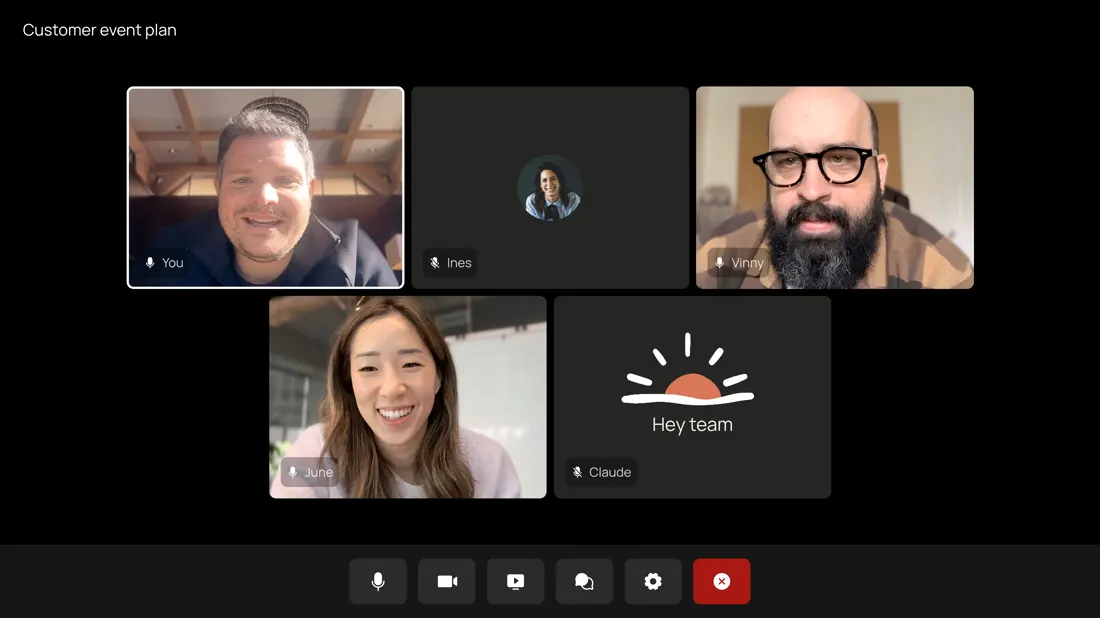
Claude Meetings (beta, November 12). On Team and Enterprise plans, Claude can join a Google Meet call as a visible participant and posts a notice in the chat. Ask it questions by voice or in the Meet chat; it answers in writing by default and can build a doc or whiteboard during the call. Afterward you get a summary, action items and the transcript. It keeps no audio.
Claude Meetings joins Google Meet as a visible participant (November 12). Image: Anthropic.
By default it stays out of calls with outside guests and leaves if one joins; admins can change that. Notes, transcripts and in-call answers are free during the beta, and documents it builds are free through February 10, 2027. Other meeting platforms are "coming soon," and it isn't available to organizations with zero data retention, HIPAA-ready setups or customer-managed keys. Transcript export to Gong, Granola, Otter, Fireflies.ai and others is coming.
Sheets, Whiteboards and Claude Data (November 10)
On all paid plans, on web, desktop and mobile:
Claude Sheets (beta): spreadsheets with tabs, formulas, formatting and drop-downs, exportable to .xlsx or CSV. Anthropic calls it "simple spreadsheet functionality."
Claude Whiteboards (beta): shared boards where Claude groups notes by theme and can turn them into a doc or deck, or export to Lucid, Miro or Vani by Zoho.
Claude Data (formerly Dashboards) is now generally available; it turns on by default for Enterprise on November 19. Sheets and Whiteboards are on by default for Team and off by default for Enterprise.
Your apps, inside Claude (November 10)
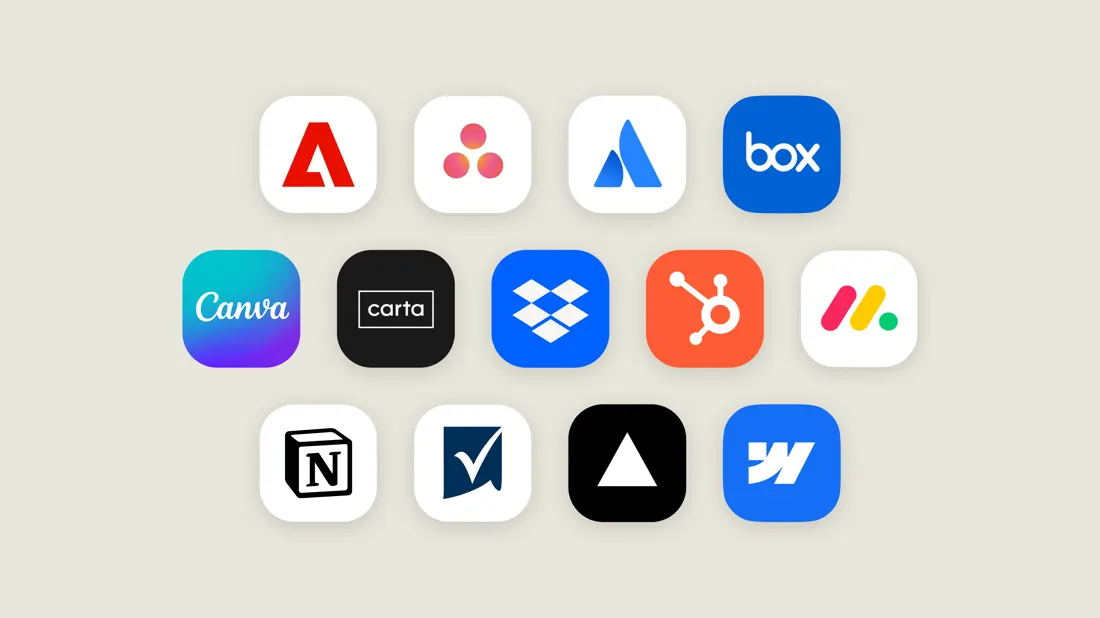
"Interactive connectors" open a tool beside the chat or full screen, and Claude edits it while you watch, approving each change. The launch set includes Asana, Canva, Carta, Dropbox, monday.com, Smartsheet, Vercel and Webflow; Figma, Harvey and Shopify are building theirs. It's built on the MCP Apps standard and rolling out on all plans on web and desktop.
Apps such as Asana, Canva and monday.com now open inside Claude (November 10). Image: Anthropic.
For business teams
Claude for Manufacturing (November 12) bundles 17 skills and connectors for Autodesk Fusion, Infor, Microsoft 365 and Oracle NetSuite; it "doesn't operate equipment." Self-hosted Claude Managed Agents (private beta, November 12) let companies run the whole agent service on their own infrastructure. JPMorganChase is rolling Claude Code out "to more employees beyond engineers" (November 9). Enterprise admins can tag projects with cost codes and see spend by tag (November 6).
Claude Code 2.1.319–2.1.323 (November 6–12)
Four releases (there's no 2.1.320):
2.1.319 (November 6):permissions.denyInsteadOfPrompting denies any tool call that would wait on a permission prompt, so unattended runs keep moving; long MCP tool calls move to the background; /claude-api latency-optimize; /tasks can reopen finished subagents; self-paced /loop now stops when a turn ends without rescheduling (CLAUDE_CODE_LOOP_KEEPALIVE=1 restores the old way).
2.1.321 (November 9): Fable 5.2 becomes the default Fable model; an account-email check no longer stops scheduled runs at a prompt.
2.1.322 (November 10): fast mode on Google Vertex.
2.1.323 (November 12): an experimental Code Mode, in which "Claude writes JavaScript to call its tools" (its docs page wasn't live when we checked); model IDs it doesn't recognize now get a 1M-token context instead of 200K (CLAUDE_CODE_DISABLE_1M_CONTEXT=1 keeps 200K); sessions on one machine can message each other far more freely; and the secrets fix in story 07.
Claude Duet: still a US waitlist preview. Reports of invite cards and a $20 price circulated on November 12–13, but Anthropic hasn't confirmed them.
Why it mattersMeetings is where a lot of office work actually happens, and Anthropic has chosen sensible defaults: visible, no audio, out of calls with outside guests. Sheets, Whiteboards and in-app connectors mean more work stays inside Claude instead of being copied out, which is convenient and also a reason for IT to check what's turned on by default.
05 · GitHub alert · Supply chainDevelopers · IT teams · All users
A secret-stealer is loose on GitHub, riding thousands of hijacked accounts. It's not a GitHub bug: it runs on stolen, valid tokens. Three checks take three minutes.#
Began about 7:45 AM ET, · vendor reports · checked
Since Tuesday morning, someone holding thousands of stolen GitHub tokens has been working through the repositories those tokens can write to. Security firms have named the campaign wfx after the branch it leaves behind (Aikido calls it "wfx-loot," StepSecurity "WFX Phantom"). It opens a harmless-looking "probe" pull request to test each token, then pushes a script that runs in GitHub Actions and steals every secret the job can see: cloud credentials, package-publishing tokens and AI keys. This is a quick security check, not an alarm. Most readers won't be affected, but the check is cheap.
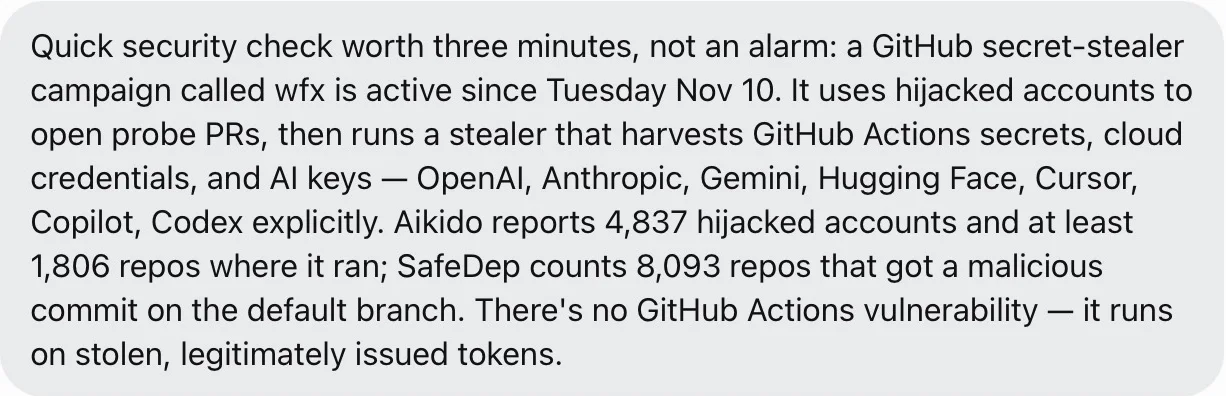
How this story started: a message from the author's Muse agent at 1:23 PM on Friday, November 13, catching the campaign and passing it on (story 15). Screenshot: the author.
Muse caught this one first. Its summary matches the vendor reports cited below, with one wording difference worth knowing: it says SafeDep's 8,093 repositories got a malicious commit "on the default branch." SafeDep's own post says the repositories "received malicious commits" and doesn't use those words; its count comes from GitHub search, which covers default branches. The table below shows each vendor's count as published.
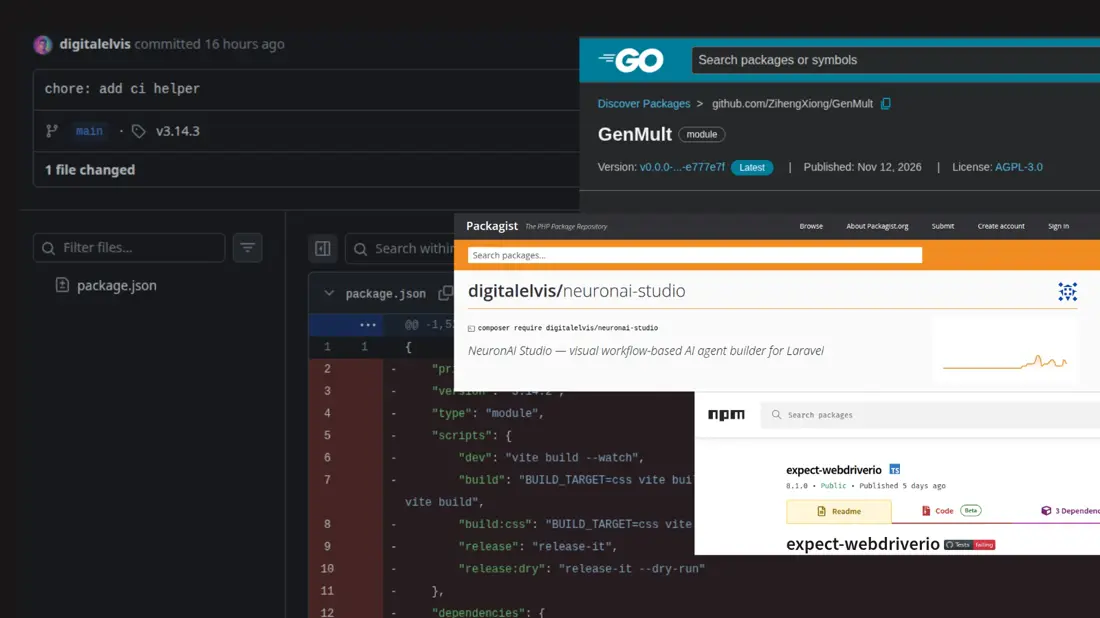
A wfx commit, "chore: add ci helper," and packages published from affected repositories (November 12). Image: SafeDep.
At a glance · wfx
Started
About 12:45 UTC (7:45 AM ET), Tuesday, November 10 (Aikido)
Accounts
4,837 hijacked accounts opened probe PRs in 61,764 repositories (Aikido)
Ran in
At least 1,806 repositories, by Aikido's count
Malicious commits
8,093 public repositories, November 10–12 (SafeDep)
Steals
Actions secrets, cloud keys, SSH, Kubernetes and Vault credentials, and AI keys
GitHub
No public statement found as of November 13
How it works
Based on Aikido, SafeDep, StepSecurity and Endor Labs (November 11–12). Diagram: The AI Enthusiast.
The probe. A pull request titled docs: dependency audit notes, from a branch named wfx-docs, that adds a single file, docs/wfx-audit.md. It only tests that the token can write. Aikido found 10,431 of these PRs in repositories the account doesn't own, and 92% were still open.
The stealer. It's then pushed directly, not through the PR: about 1,500 lines of shell added to an existing workflow; a hidden .ci-xxxxxx.sh script run by an npm postinstall hook, which also runs on developers' own machines; or a new .github/workflows/build-audit-xxxxxx.yml on a throwaway chore/xxxxxxxx branch. StepSecurity also saw code appended to CI shell scripts.
The haul. It dumps every secret and variable, scrapes the runner's memory, and collects cloud, SSH, Kubernetes and Vault credentials. It uses GitHub's OIDC tokens to log in to AWS, Google Cloud and Azure, and plants backdoors that survive a password change: new AWS access keys, role trust policies opened to "AWS": "*", and Azure federated credentials named wfx-ci-<n>.
The AI keys. Aikido lists the AI credentials it hunts for: OpenAI, Anthropic, Gemini, Hugging Face, Cursor, Copilot and Codex, plus Continue, Codeium, Aider, Weights & Biases and Ollama.
The cover-up. It reverts its own commit within about a minute ("ci: restore" or "ci: cleanup") and deletes the workflow run and its logs.
The attacker does not exploit a bug in GitHub Actions.StepSecurity · November 12, 2026
Who counted what
The vendors agree on the shape and disagree on the totals, because each counts something different.
wfx campaign counts by security vendor
Source
What they counted
Number
Aikido
Hijacked accounts that opened probe PRs / repositories probed
4,837 / 61,764
Aikido
Repositories where the stealer ran ("may understate impact"); elsewhere in the same post, "at least 1,835" had credentials taken
1,806+
SafeDep
Public repositories that received malicious commits, November 10, 12:46 UTC to November 12, 04:36 UTC (GitHub search covers default branches)
8,093
SafeDep
Accounts / probe PRs, by its own search
4,833 / 61,879
Endor Labs
Repositories showing payload evidence
8,926
StepSecurity
Probe PRs / "ci: refresh build cache" commits
63,000+ / 21,000+
How the accounts were taken
Nobody knows for sure. Aikido, SafeDep and StepSecurity all say they don't know how the tokens were stolen. Two partial answers: Fly.io says tokens for its GitHub App were left in .git/config inside some customers' deployed apps, and a few apps served that file to anyone who asked; it says its own systems weren't breached and began revoking every token its app had issued. Endor Labs cites one victim whose leaked GitHub CLI sign-in was used. Aikido links wfx to October's GhostAction campaign but judges them to be different attackers.
The three-minute check
If you own or manage repositories, look for any of these since November 10. The full commands are in tip 8.
Pull requests: search your account or organization for the title docs: dependency audit notes, or a head branch named wfx-docs.
Commits and branches: the messages ci: refresh build cache, chore: add ci helper, chore: add dependency audit workflow, ci: restore or ci: cleanup, and branches named chore/ plus eight characters or ci-check- plus four digits.
Actions history: gaps in workflow run numbers. Deleted runs still show in the organization audit log.
Also on the indicator lists: files .ci-[6 characters].sh and .github/workflows/build-audit-[6 characters].yml; workflow steps named "Pass runtime," "Run audit" or "Restore cache"; AWS sessions named wfx-*; artifacts named wfx-loot-<run id>; and traffic to 194.150.166[.]244, 18.143.168[.]96, 153.75.82[.]159 or, since about November 12, Telegram's API. SafeDep publishes the full indicator list and the affected-repository list as CSV files.
If you find something
Treat the account that opened the PR as compromised. Revoke its personal access tokens, OAuth and GitHub App grants, SSH keys and sessions, and require two-factor sign-in.
Rotate every secret the job could reach, not only the ones the workflow named: repository, environment and organization secrets, package-registry tokens, cloud keys, AI provider keys, and self-hosted runner credentials.
Remove the cloud backdoors, because rotation alone won't. In AWS CloudTrail, look for AssumeRoleWithWebIdentity with wfx-* session names followed by CreateAccessKey or UpdateAssumeRolePolicy. In Entra ID, delete wfx-ci-* federated credentials.
Clean up. Delete the branches, close the probe PRs, republish any package built during the exposure, and treat any laptop that ran npm install on an affected commit as compromised.
Harden (exact setting paths are in the how-to guide). Make GITHUB_TOKEN read-only by default, require pull requests on default branches (admins included), require code-owner review for .github/workflows/ and package.json, keep deploy secrets in protected environments, and scope cloud OIDC trust to specific repositories and branches.
What GitHub has said: nothing public that we could find on its blog or changelog as of November 13, and Endor Labs says no takedown has been announced. Fly.io says its own token revocation "stopped partway" and GitHub support is investigating. A GitHub feature from November 9 helps after the fact: secret scanning can now find secrets printed in Actions workflow logs (public preview, GitHub Enterprise Cloud with Secret Protection; story 06). Issue 31's tip 12 was about pull_request_target workflows; wfx doesn't use them, so that fix alone doesn't stop it.
Why it mattersYour AI keys are now on the attackers' shopping list, next to cloud credentials, and a stolen key spends your money and reads your data. wfx needed no clever exploit: one leaked token that can write to a repository was enough. That makes tokens the real perimeter. Give them the least access you can, put the secrets that matter behind protected environments, and check that you'd notice a commit that deletes itself a minute later.
06 · GitHub · Beyond CopilotDevelopers · IT teams · Power users
Beyond Copilot: GitHub rebuilds itself for a world of agents. A new Git storage system built for 5,000 agents on one repository, sessions that follow you between devices, and a Copilot that remembers.#
GitHub Universe – (background) · new Git storage post · Slack and Teams GA · log scanning and Fable 5.2 · Gemini 4 Carbon · Enterprise Server in the Copilot app
Issue 30 covered Universe's Copilot headlines: Fusion model routing, verified connectors, Projects and computer use. On November 12 I sat in on a GitHub-led customer session called "Beyond Copilot: The Full GitHub Platform." Its point was that the AI assistant is now the smallest part of the story. GitHub is rebuilding the storage underneath for agents, moving work into the cloud so it follows you, and teaching Copilot to remember. This story sorts what's generally available from what's still a preview, and how to turn each on.
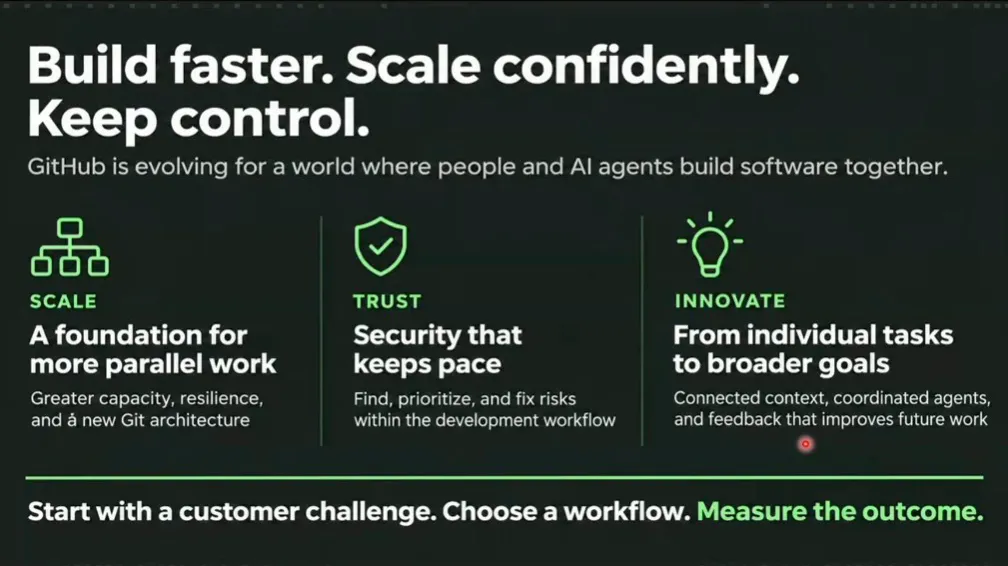
The session's framing slide: scale, trust and innovate. This wording appears on the slides, not in GitHub's public posts; its Universe keynote post talks about velocity, intelligence and quality. Slide: GitHub, November 12.
At a glance · GitHub this fortnight
Scale
"Rubicon," a new Git storage system: 5,000 concurrent agents and 7,200 pushes a second on one repository; limited private preview
Trust
Secret scanning in Actions logs (preview, November 9); no public word yet on wfx (story 05)
Follows you
Connected cloud sessions and cloud sandboxes, GA on paid plans; @GitHub in Slack and Teams, GA November 6
Remembers
Copilot Memory GA; Dreaming in public preview; automations that propose their own improvements
Models
Claude Fable 5.2 (November 9, off until an admin turns it on) and Gemini 4 Carbon (November 10, on by default)
Billing
Cloud sandbox time starts billing in November, from a shared dollar-based Actions pool
Scale: a new Git storage system, built for agents
On November 5, GitHub engineers Karthik Raman and Brian Celenza described Rubicon, the "new Git architecture" on the slide. The problem is agents: they push far more often than people, and in parallel. GitHub says one repository's traffic grew about 4x from March to May. Rubicon separates storage from compute so a busy repository can add machines instead of waiting on one server. GitHub cites 5,000 concurrent agents working on a repository and 7,200 pushes per second to a repository. It's in limited private preview now, with a broader rollout "early next year." Separately, the Universe keynote said GitHub added 4 million CPU cores, 160 PB of storage and 50 Tb/s of network this year.
Simplified from "Inside GitHub's new Git storage architecture" (GitHub, November 5). Diagram: The AI Enthusiast.
Trust: security that keeps pace
Secret scanning in Actions workflow logs (public preview, November 9). Finds secrets that a workflow printed to its logs. It needs GitHub Enterprise Cloud with Secret Protection or Advanced Security, and an enterprise owner turns on a policy. It doesn't scan old logs, and there are no notifications during the preview.
Smaller changes. SpaceX joined the secret scanning partner program and six detectors were upgraded (November 5); a Cloudflare service-token detector arrived (November 12); and AI Scan for repositories, a code-scanning preview, can now be managed through the REST API (November 13).
A date to note. From December 8, Dependabot alerts pause on repositories with no activity for a year (November 10).
wfx. The week's real test of "trust" came from outside: see story 05. GitHub hadn't commented publicly when we checked.
Also from GitHub: CodeQL, and Spec Kit for planning before you code
CodeQL 2.27.4 (GitHub changelog November 4; CLI release November 2). An accuracy release: fewer false positives in the Java/Kotlin, Rust and C/C++ queries, and the CWE-730 tag removed from the regex-denial-of-service queries. One security fix: codeql pack bundle and codeql pack publish now skip files whose symlinks point outside the pack, with a warning. It reaches github.com code scanning automatically and ships in GitHub Enterprise Server 3.24.
CodeQL 2.27.3 (CLI release October 20). On macOS 27 and Xcode 27, Apple stopped shipping multi-architecture binaries, so the autobuild and manual build modes aren't supported there for compiled languages. JSON data extensions now work, and GitHub Actions databases can be downgraded again.
AI Scan for repositories (public preview, October 28). Scans a whole repository with AI, not only a pull request's changes, and covers languages CodeQL doesn't. An enterprise must allow the AI Scan policy first; then organization owners or security managers turn it on. No Copilot license is needed, but it uses Code Security AI credits, and a merged fix doesn't trigger a re-scan. Background: AI Scan for pull requests went generally available on October 15; its findings are advisory and don't block merges. (Details from GitHub's changelog summaries.)
Does CodeQL stop wfx? We found no source saying so, and no source tying CodeQL to wfx at all. GitHub's relevant controls are platform settings: pull_request_target is blocked by default in public repositories from December 2 (changelog November 2; Issue 31's tip 12), and workflow execution protections reached general availability on September 17. Neither addresses a stolen token that is allowed to push.
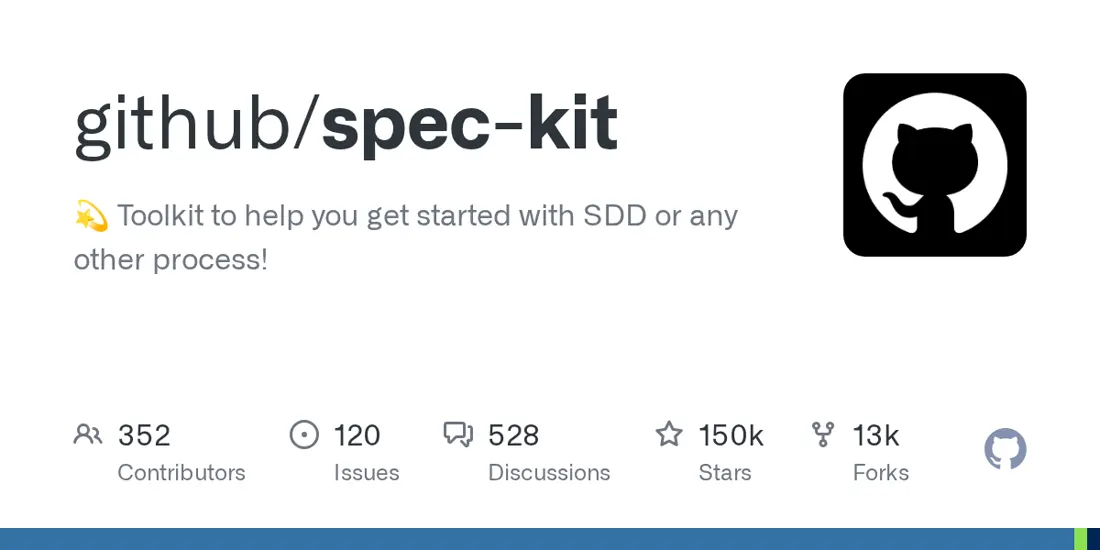
Spec Kit, GitHub's open-source toolkit for spec-driven development: about 150,000 stars, MIT license. Image: GitHub.
Spec Kit (github/spec-kit, speckit.org) is an MIT-licensed toolkit that makes your coding agent write a specification, a plan and a task list before it writes code. It's open source, works with several agents (Copilot is the README's example; the project site lists Claude Code, Cursor, Gemini CLI and Windsurf), and its newest release is v1.4.0 (November 10), after v1.3.3 (November 9) and v1.3.2 (November 6). Its core commands, run one at a time in the agent's chat, are /speckit-constitution (project rules, once), /speckit-specify, /speckit-plan, /speckit-tasks, /speckit-implement and /speckit-converge, with optional extensions for bug fixing and idea assessment. It fits this issue's theme: the cure for agents that run fast and wrong is a written spec a person approves first. Tip 13 has a five-minute start, and the full how-to guide covers Spec Kit in Copilot step by step, plus a leaked-key and security scan with fixes. Note: speckit.org still shows older install steps and dotted command names; the GitHub README is current.
Innovate: what the slides promised, and what you can use today
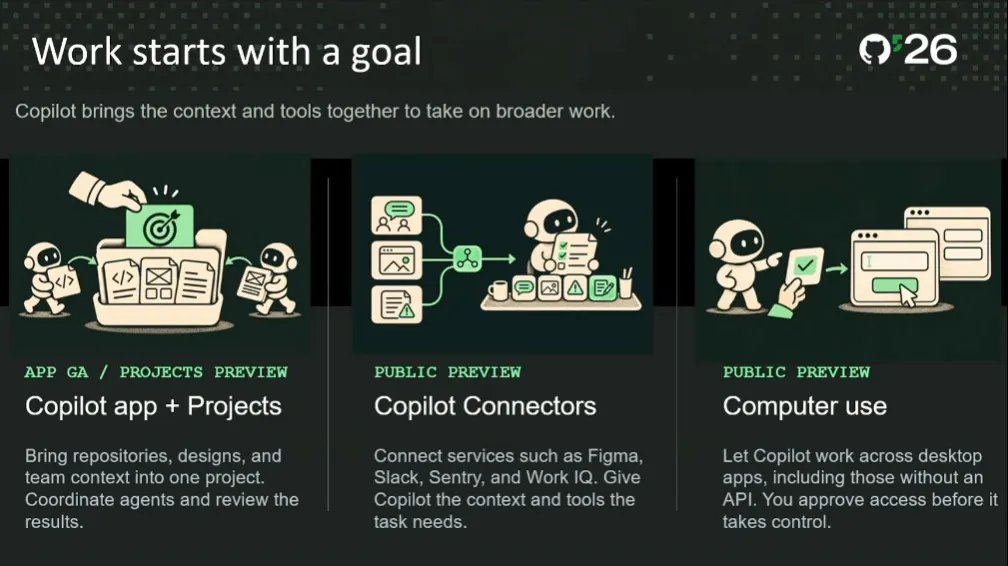
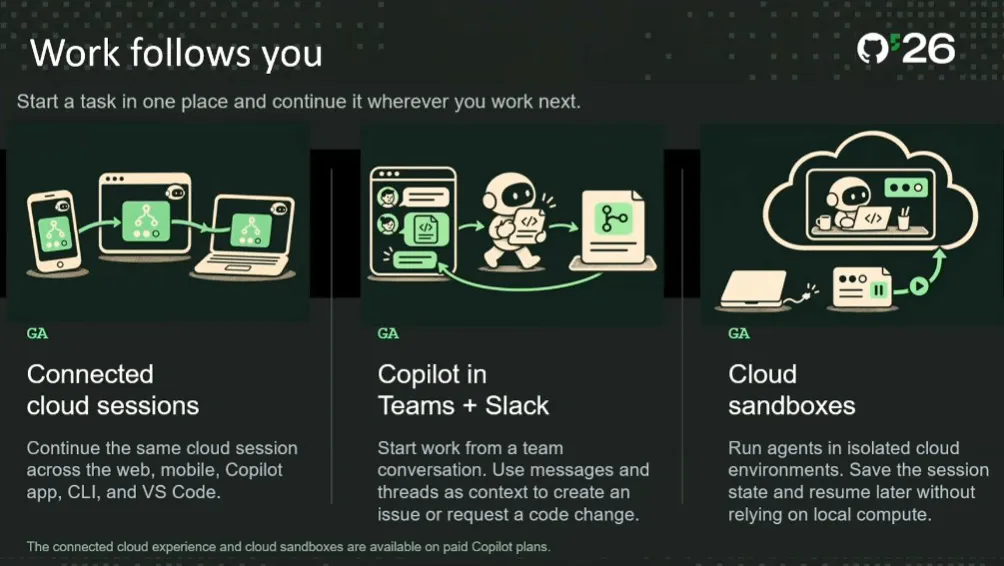
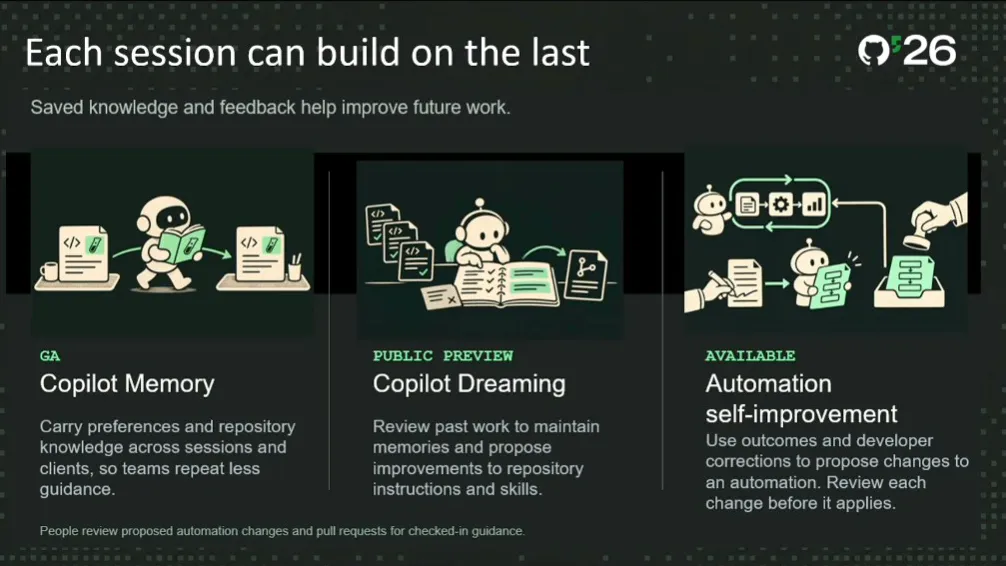
Work starts with a goal. Slide: GitHub.Work follows you. Slide: GitHub.Each session can build on the last. Slide: GitHub.
We checked each slide item against GitHub's own changelog. Rows marked Issue 30 were covered there.
GitHub Copilot platform features from the session, with status, plans and how to turn each on
Feature
Status
What it does
Plans
Turn it on
Copilot app
GA (June 17); all plans July 6
Desktop app for agent sessions on macOS, Windows and Linux. New November 13: GitHub Enterprise Server support
All Copilot plans
Download from GitHub
Projects
Public preview, Oct 28 (Issue 30)
Describe a goal, add repositories and notes; agents work across repos and return pull requests
Not stated
Update the Copilot app
Connectors
Public preview, Oct 28 (Issue 30)
26 GitHub-verified MCP servers (Slack, Figma, Sentry, Work IQ…); connect once, use everywhere
All; Business/Enterprise need the "Editor preview features" policy
App: Customize › Connect · CLI: /mcp › Connectors
Computer use
Public preview (Oct 1; Issue 30)
Copilot works in desktop apps, including ones with no API; asks before it takes control
Copilot app and CLI, macOS and Windows
App: Settings › Computer Use › Enable (macOS: grant Accessibility and Screen Recording)
Connected cloud sessions
GA, Oct 28
One session list across web, mobile, CLI, the app, VS Code, Slack and Teams: "One session, every surface"
Paid Copilot plans
Copilot page, a repo's Agents tab, or Mobile; admins use the "Copilot in the cloud" policy
Cloud sandboxes
GA, Oct 28
Agents run on GitHub's machines with no one-hour limit; a snapshot saves the session so you can resume later from anywhere
Paid plans; billing starts in November
Same as above
@GitHub in Slack and Teams
GA, Nov 6
Ask in a thread to investigate a bug, open an issue or propose a pull request; Teams gets a Canvas to review plans and changes
Paid plans (per the October 28 post)
slack.github.com or teams.github.com
Copilot Memory
GA, Oct 28
Remembers your preferences and repository conventions across sessions and tools
Paid plans
View or delete memories in Copilot settings
Dreaming
Public preview, opt-in, Oct 28
Reviews past sessions and review comments to tidy memories; changes to instructions and skills arrive as pull requests. Uses AI credits
Organizations: admin policy
Personal: Copilot settings · per repo: repository settings
Automation self-improvement
Available, Oct 28
Uses outcomes and your corrections to propose changes to an automation's prompt, tools or triggers; "each proposed change comes to you for review"
Pro, Pro+, Max, Business, Enterprise
Ask Copilot to set up a self-improving automation
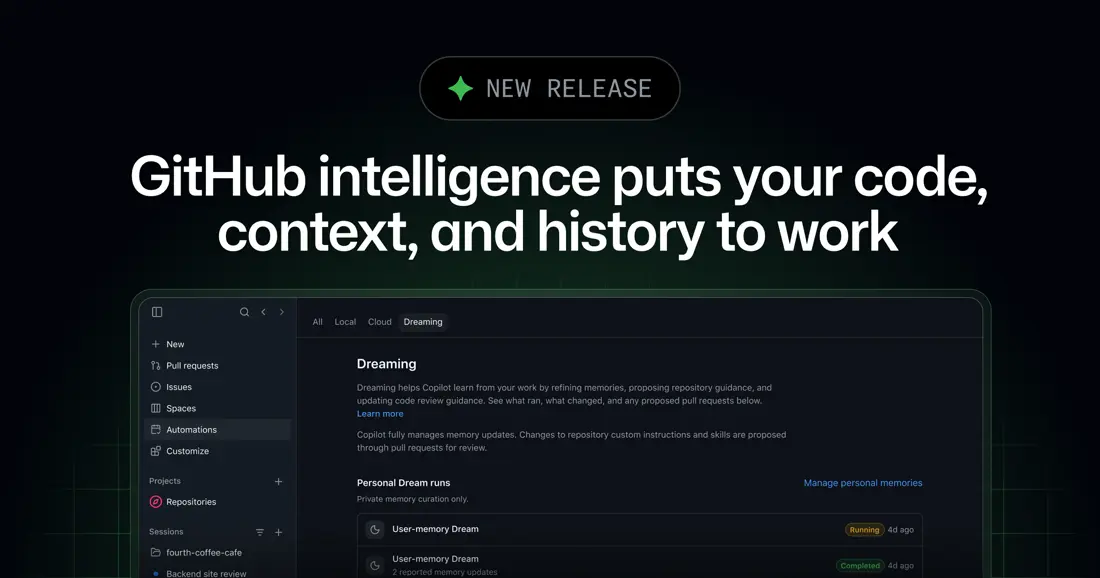
Dreaming curates Copilot's memories and proposes changes to instructions and skills as pull requests (October 28, background). Image: GitHub.
New models in Copilot this week
Claude Fable 5.2 arrived on November 9 for Pro+, Max, Business and Enterprise, billed at the provider's list price. It's off until an admin turns on its policy, and Anthropic keeps prompts and outputs by default for its safety classifiers, with a limited zero-retention exception through year-end for eligible enterprises. Gemini 4 Carbon followed on November 10 for the same plans, and it's on by default unless an admin has turned it off (story 01).
What to do with this
Everyone with repositories: run the wfx check first (tip 8).
Copilot users: open Copilot settings and read what Memory has saved about you. Delete anything wrong before it shapes the next session (tip 12).
Admins: decide on purpose whether Fable 5.2 and Gemini 4 Carbon should be on, given their different defaults and retention terms.
Teams with automations: try self-improvement on one low-risk automation, and review every proposed change like a pull request.
Budget owners: cloud sandbox time now bills from the shared Actions pool. Check usage after the first month.
Why it mattersThe session's last line was "Start with a customer challenge. Choose a workflow. Measure the outcome." That's the right order. GitHub now offers memory, cloud agents and self-improving automations; the useful question is which one problem each solves for you. And in the same week, wfx showed that the platform's real limit is how well you guard the tokens that drive it.
"Beyond Copilot: The Full GitHub Platform," a GitHub-led customer session, November 12, 2026 (not published online; the slide images are our screenshots, cropped to the slides)
07
07 · Agent securityDevelopers · All users
"Don't ask again" saved passwords into public code. And a web host traced a breach of 56 customer sites to its AI connector.#
–
When you choose "don't ask again" on a command prompt in Claude Code, it saves that exact command as an allow rule in .claude/settings.local.json, including any password typed into it. Security firm Apiiro (published about November 5, on the window's edge; covered November 7 onward) searched GitHub and found 104,185 public copies of that file. 1,122 contained at least one secret, 1,379 in all: 379 database passwords, 122 Supabase service keys, 43 SSH logins, 42 code-registry tokens and 23 AWS keys (self-reported).
215 of them slipped past both of the popular secret scanners gitleaks and TruffleHog, mostly passwords typed inline (PGPASSWORD=, sshpass -p, mysql -p). Apiiro didn't test whether they still worked. The Hacker News thread drew close to 600 points.
The fix (Claude Code 2.1.323, November 12)
"Don't ask again" no longer writes to a settings.local.json that git tracks; the rule lasts only for the session. Rules that look like they contain a secret are session-only too. The file is now ignored by git even when a folder becomes a repository later, claude auth logout also removes saved MCP sign-ins and plugin secrets, and Claude's own search and git commands run without most sign-in tokens. Tip 9 shows how to check your repositories.
Also from Claude Code's issue tracker (follow-up)
A GitHub issue opened November 5, "Claude Code sends your email address to websites," reached about 1,600 points on Hacker News. It reports the account email appearing in the User-Agent header of some web requests. Anthropic pointed to a built-in privacy mod added in 2.1.317, and 2.1.321 (November 9) now refuses shell commands that contain your email and name a User-Agent. The issue is still open.
The MCP breach
Mittwald, a German web host, says an attacker exploited a flaw in its MCP server, which connects its control panel to AI assistants, and read session tokens of customers who used it. 56 customer projects were compromised; passwords weren't taken. In its November 7 post, managing director Robert Meyer gave the timeline: first probing October 21, exploitation from October 27, the server shut down November 4. He told The Record that the logs suggest AI tools sped up the attack. On November 12, attacks resumed and Mittwald took its site and control panel offline again as a precaution, according to a German IT blog citing its status page. The MCP server stays off.
Mittwald traced the breach of 56 customer projects to its MCP server (November 7). Image: Mittwald.
AI attacks will become more frequent in the future.Robert Meyer, Mittwald, to The Record · November 9, 2026
Two more MCP warnings
Researchers at Corelight found that popular ways of launching MCP servers fetch fresh dependencies on every rebuild. One server was rebuilt 19 times in five weeks and came up with 15 different sets of packages (reported November 11). AWS disclosed a server-side request forgery flaw, CVE-2026-125926, in its open-source mcp-gateway-registry (versions 1.0.3–1.34.0; fixed in 1.35.0, November 13). Upgrading doesn't clean up entries already registered.
Why it mattersThese are the unglamorous ways agents leak: a convenience button that writes secrets to disk, and a connector that hands an attacker a session. None needed a clever AI exploit, and neither did wfx (story 05). If your team uses coding agents or MCP connectors, treat their settings files and servers like any other production credential store.
ChatGPT's agents can now pay for things. Plus a storefront for businesses, an $11 billion first close, and old voice mode's last month.#
–
ChatGPT Wallet (November 13). OpenAI's "dots" agents can now make purchases. Built with American Express, Mastercard and Visa, it works like this: you enter a card once, approve each purchase with a check, and the card network issues a single-use payment token, so the agent never sees your real card number. You keep your card's rewards and protections. It's for US Pro subscribers aged 18 and over only, and OpenAI takes no cut of purchases at launch. Amex's Luke Gebb called the small rollout the "right approach to make sure things are working." (Only CNBC has reported details so far; OpenAI's own page was blocked to our fetcher.)
Businesses in ChatGPT (beta, November 10)
Companies can claim a verified profile through Business Hub in the ChatGPT sidebar on the web, after identity verification with Persona, and see 28 days of aggregate mentions, clicks and topics. Eligible US online stores and service businesses can also get a free Business Agent that OpenAI builds from their instructions and product feed and that hands shoppers off to the company's own site to buy. Paid "sponsored agents" are being tested as ads. OpenAI says taking part doesn't change how often ChatGPT recommends a business.
Think of the business agent as the organic experience… The sponsored agent is the paid experience.Benji Shomair, OpenAI · November 10, 2026
The money (follow-up to Issue 31)
Issue 31 noted the FT's report that OpenAI cut its round target to about $20 billion. Bloomberg and Reuters reported on November 6 that OpenAI closed a first $11 billion at a $1.25 trillion valuation, with up to $9 billion more possible. On November 10, Bloomberg, The Information and the WSJ reported Q3 revenue of about $10 billion, up about 50% on the quarter, and an adjusted operating loss of about $10.9 billion. OpenAI didn't comment. For comparison, Anthropic reported $17 billion for the same quarter (story 02).
Voice changes (notice November 10)
On December 11, ChatGPT retires Advanced and Standard voice and moves everyone to GPT-Live. Live video and screen sharing stay on Advanced voice until GPT-Live supports them. Some users complain that GPT-Live interrupts more.
Also: ChatGPT's personal-finance feature came to the Mac app for US users (November 11). "It won't buy stocks, move money or place orders on your behalf."
Why it mattersOpenAI now wants to sit at both ends of a sale: Business Hub for the shop, Wallet for the shopper. For retail teams, a ChatGPT business profile is becoming as basic as a Google Business listing, and the ad version is already being tested. For shoppers, single-use card tokens and approval for every purchase are the right defaults.
Gemini in Gmail is now on by default for every Workspace user. And DeepMind's agents checked Signal's code line by line.#
–
Workspace (November 9–11)
Gemini in Gmail for everyone (November 10). AI Overview thread summaries and non-personalized "Help me write" now reach all Workspace customers, including Individual and personal accounts, for users 18 and over with smart features on. They're on by default; users and admins can turn them off. Expect them within 15 days.
Book a meeting from a chat (November 9–10). In Google Chat direct messages and groups of up to five, Gemini spots a meeting request and offers up to three open times. Web, English, business plans.
Share a Sheets canvas as a link (November 11). The interactive mini-apps Gemini builds in Sheets can be published as a read-only link, without sharing the spreadsheet. Business plans and Google AI Pro/Ultra.
Workspace Studio "Wait until" (November 9). Automated flows can pause until a set time, such as next Monday at 8 AM, or for up to 14 days.
DeepMind (November 10–11)
AlphaProof Code (November 10): agents built on Gemini Carbon wrote more than 6 million lines of formal Lean proofs of security properties in Signal's compiled libsignal code in about four weeks, with about 1% flagged for human review. Two old, already-fixed bugs were put back in as a test, and both were caught. No new vulnerabilities were found, and this doesn't certify the full Signal apps.
AlphaGenome 2 (November 11): trained on more than 107 million single-cell profiles, it found about 30% of disease-causing genetic variants in a test, against 16% for earlier tools. Free for non-commercial research; not for clinical use.
AlphaProof Code wrote more than 6 million lines of Lean proofs about Signal's code (November 10). Image: Google DeepMind.
Pixel (November 11)
The November Pixel Drop adds Create My Widget (describe a widget and Gemini builds it from Gmail, Calendar and Search), Gemini call screening on Pixel 11 in the US, and Rambler voice typing that drops the "um"s.
The November Pixel Drop adds Create My Widget and Gemini call screening (November 11). Image: Google via FoneArena.
Why it mattersTurning Gemini in Gmail on by default puts AI summaries in front of millions of people who never asked for them, and admins who haven't decided yet should decide now. AlphaProof Code is the more important long-term story: AI writing mathematical proofs that real software is safe could flip AI from a cyber threat (story 10) into a defense.
Attackers let AI run the break-in. And North Korea stole $400 million with faked video calls.#
–
Autonomous AI attacks (November 12). Palo Alto Networks' Unit 42 tracked 25 operations against at least 19 organizations (August–September 2026) in which attackers used an open-source penetration-testing framework, Cairn, driven by Chinese AI models: Zhipu GLM 5.2 in 13 operations and DeepSeek V4 in 12. Access or data theft was confirmed at 10 organizations. One exposed more than 1 million personal records, and another lost about 150,000 internal documents.
Targets included chipmaking suppliers, defense-policy groups and civil-society groups, among them a US teachers' union. Unit 42 attributes it, with moderate confidence, to China-linked intelligence collection. Each operation wrote itself a file falsely declaring the activity "authorized."
Unit 42 tracked 25 autonomous AI intrusion operations (November 12). Image: Shutterstock via CSO Online.
Autonomous AI raises the volume and coverage of exploitation, but not its complexity… Identity hygiene, attack-surface reduction and software patching remain effective.Unit 42 · November 12, 2026
Operation Snowball
A second case (Malbear Labs, November 8; reported November 9): a jailbroken DeepSeek agent spent more than two weeks inside a European telecom, getting in through a Cisco flaw patched in August but never applied. It switched methods by itself when security software blocked it. The operator "delegated the intrusion to an AI and checked in asynchronously." Claims about stolen data aren't verified.
FaceStealer (November 12)
The Justice Department and FBI said North Korean hackers stole more than $400 million in 18 months using fake Zoom, Teams and Google Meet pages. The scheme: an invite arrives from a hijacked account of someone you know; the "call" plays recorded webcam video of that person; then they claim an audio problem and send a "fix" that installs malware. Thieves sometimes wait months before emptying crypto wallets. The FBI seized the scheme's cloud servers and 900+ recorded victim videos, and it has set up fbi.gov/facestealer. The scheme also uses AI deepfakes of well-known crypto figures.
It exploits our trust in ubiquitous video conference platforms and valued personal relationships.Patrick Grandy, FBI · November 12, 2026
Deepfake bosses (reported November 9)
Federal prosecutors in New York charged three men over a $129 million scheme (2024–2026) that used AI-cloned voices or images of CEOs, plus fake lawyers, to direct wire transfers. Victims included two hospital systems (about $7.8M) and a Rhode Island bank ($2.7M).
Why it mattersAI hasn't invented new attacks; it has made old ones cheap and tireless. A "line item on an API bill," as one analyst told CSO Online, now does what used to take a team. The defenses are the boring ones: patch, lock down sign-ins, and confirm any unusual request on a second channel. Tip 6 has the FBI's checklist.
Four nonprofits sue to freeze frontier AI. New York's safety law starts counting, and the Senate moves to make data centers pay for power.#
–
The "freeze" lawsuit (November 12).Public Citizen, the Irreplaceable Education Fund, Heat Initiative and The Alliance for Secure AI sued Anthropic, Google, Meta, OpenAI and SpaceXSI (SpaceX's AI unit) in San Francisco Superior Court, under California's unfair-competition and public-nuisance laws. They ask the court to freeze development of more advanced models until the companies show the technology is under human control. Former New Jersey attorney general Matt Platkin filed it. The complaint leans on the labs' own warnings. No hearing has been set, and the companies hadn't responded publicly. Background: a September class action accused the same labs of illegally agreeing to go slower.
We must freeze frontier AI development until the technology is under control.Phil Aroneanu, Irreplaceable Education Fund · November 12, 2026
New York's RAISE Act (November 10)
New York opened registration for its frontier AI safety law. Developers with more than $500 million in annual revenue must register by January 1, 2027, publish safety frameworks, and report critical safety incidents within 72 hours (California allows 15 days). Fines reach $1 million per violation and $3 million for repeats. A new state office, DIGIT, oversees it. Governor Kathy Hochul: "We're building a national model for smart, sensible AI regulation."
New York opened registration for its AI safety law on November 10. Image: Angelina Katsanis/Bloomberg/Getty Images via TechCrunch.
Congress after the midterms (follow-up to Issue 31)
On November 9, in its first major vote since the election, the Senate voted 73–25 to take up a bipartisan permitting bill that would make data centers pay for the energy they use and their grid costs. It still needs a final Senate vote and the House. The same day, Reuters reported President Trump telling 60 Minutes, "I don't mind guardrails" on AI, as long as rules don't put the US in "a deep second position" behind China. There was no movement on federal preemption of state AI laws.
Schools and Europe
November 10: Anthropic signed a legally binding student-privacy agreement with the AFT and UFT teachers' unions: student and teacher data only for authorized educational purposes, with no training on it and no ads. "One step closer to an industry standard," said the AFT's Randi Weingarten. November 12: the EU published its guidelines for labelling AI-generated content in the Official Journal. AI systems on the market before August 2 must mark their output in a machine-readable way by December 2, 2026, the same day new EU bans on AI "nudifier" apps take effect.
Why it mattersThe freeze suit is a long shot, but it's built from the companies' own words, and it lands the same week Anthropic said its AI is speeding up its own research (story 02). Meanwhile the practical rules keep arriving state by state: New York's 72-hour incident clock starts in January, and anyone building on frontier models should know which lab it applies to.
VS Code gets an inbox for your agents, Cursor takes voice calls, and n8n 3.0 is still a few weeks away.#
– · n8n: follow-up to Issues 30–31
VS Code 1.146 (November 11). The Agents window gets an experimental Inbox mode for agent sessions, inline buttons to fix failing checks or answer review comments, chats in their own windows, and Skills over MCP (preview), so MCP servers can supply skills. Type /code in GitHub Copilot CLI (1.0.107 or later, experimental features on) to continue that session in VS Code. The old Local harness is deprecated and will be removed in February 2027.
VS Code 1.146 adds an Inbox for agent sessions (November 11). Image: Microsoft.
Elsewhere
Cursor (November 6) added voice calls with agents in the Agents window, the editor, the web and iOS ("Hey Siri, call Cursor"), powered by Grok Voice. GitHub made @GitHub in Slack and Teams generally available the same day (story 06). Chrome's Modern Web Guidance 1.0 (November 10) is a set of skills that steers coding agents away from outdated JavaScript, with Firefox and Edge joining; install it with npx modern-web-guidance@latest install.
MCP itself. The protocol's maintainers announced a more predictable release cycle (November 11) and previewed an extension for moving files between apps and tools (November 10).
CLIs.Codex CLI 0.169.0 (November 13) keeps project config and MCP servers off in folders you haven't trusted (codex exec --trust saves trust on purpose). Gemini CLI 0.68.0 (November 10) adds a rate-limit countdown and a SubagentStop hook. Copilot CLI 1.0.110 (November 12) can answer sudo and SSH password prompts in a masked dialog (experimental).
n8n (follow-up)
Issue 30 featured n8n and Issue 31 covered the 3.1.0 pre-release. Version 3 is still a pre-release (3.2.2 on November 13). n8n's community post says stable 3.0 is "scheduled for early December," and 2.x will get security fixes for 12 months after that. The current stable release is 2.47.7 (November 13).
Why it mattersEvery coding tool now assumes you're managing several agents at once, and the interfaces are converging on an inbox, a voice line and a chat thread. The MCP stories in 07 are the reminder that the plumbing underneath is still young. For n8n users, there's no reason to move production workflows to 3.x before December.
Cisco's best growth in 15 years, CoreWeave's $132 billion backlog, and a $7 billion loss at SoftBank.#
–
Cisco (November 12). Record first-quarter revenue of $18.5 billion, up 24%, with product revenue up 32%. Cisco now expects $9 billion of AI infrastructure revenue from the big cloud companies this fiscal year, up from $7.5 billion in August, and raised full-year guidance to $74.8–75.8 billion.
In Q1, we delivered the strongest revenue and non-GAAP earnings per share growth rates for Cisco in over 15 years.Chuck Robbins, Cisco · November 12, 2026
Cisco reported record revenue of $18.5 billion on November 12. Image: Cisco.
CoreWeave (November 10). Q3 revenue of $3.66 billion, up 168%, and a backlog of about $132.5 billion. It raised 2026 guidance to $13.0–13.3 billion. It also lost $709 million and carries about $47 billion of debt, per SiliconANGLE. The stock jumped about 25% the next day after losing more than 40% in a month, then fell 12% on November 12 with Nvidia (story 03).
SoftBank (November 10). SoftBank, a major OpenAI investor, reported a July–September net loss of about ¥1.1 trillion (about $7 billion), against a profit a year earlier.
Why it mattersStrip out the Nvidia drama and the AI buildout is still producing real revenue for the companies that sell the networks and the rented chips. Cisco's numbers matter to IT teams because they show the spending isn't only at the hyperscalers. CoreWeave's debt is the reminder of who carries the risk if demand slows.
AI shopping agents flood store sites, but almost none reach the checkout. Amazon lets you text yours.#
–
Who sends the agents (published November 9). HUMAN Security's October report on agent traffic to its customers' sites found Meta's Muse sending 59% of AI agent requests and ChatGPT Agent 16%, with OpenAI's Codex browser tools adding about 14% more. Meta and OpenAI together: about 89%. Agent traffic rose 157.5% in a month and about 8x since August. But 85.2% of agent visits land on product or search pages and just 1.9% reach checkout or payment. Ecommerce gets about 60% of all agent traffic. HUMAN only sees its own customers, and the counts include blocked requests. (Figures via PPC Land and MediaPost; we couldn't find HUMAN's own page.)
Meta and OpenAI send about 89% of AI agent traffic, per HUMAN Security. Image: PPC Land.
Amazon's texting agent (November 6)
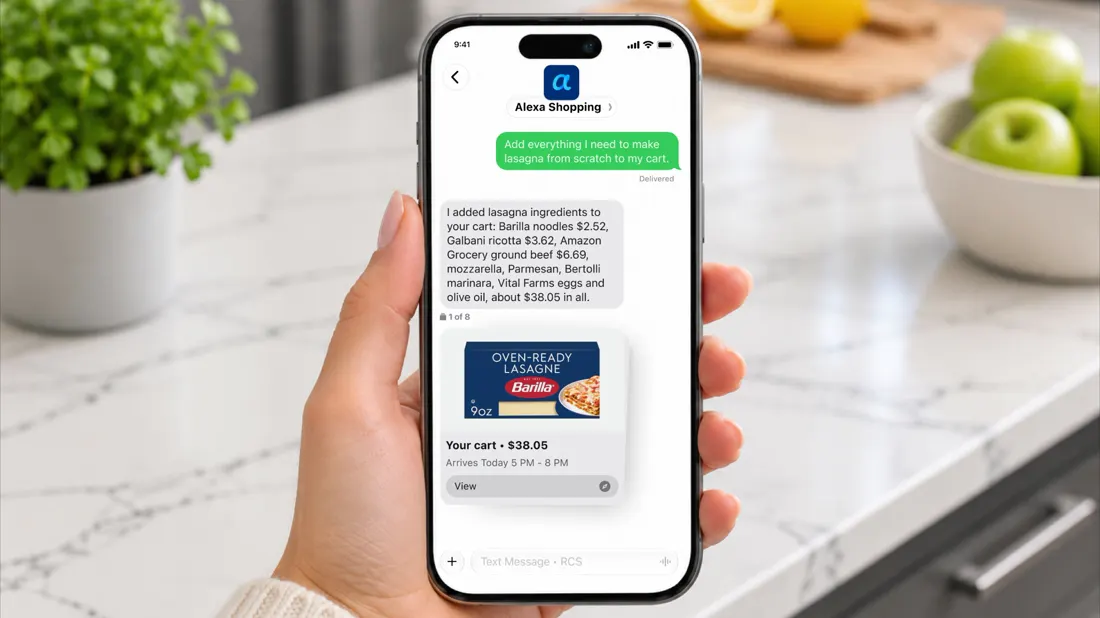
Select US customers can now text Alexa for Shopping to search, compare, add to cart and buy, including from a photo of a recipe, plus reorders and price tracking. It's invite-only, with "millions more customers in the coming weeks" (sign-up at amazon.com/text-alexa-shopping). Amazon says more than 400 million customers used Alexa for Shopping in the past year and use of its agent features is up more than 8x this year. Amazon still blocks outside agents from its store, CNBC notes.
Amazon customers can now text Alexa for Shopping to buy (November 6). Image: Amazon.
Who's saying no
United Airlines now bars "unauthorized, third-party personal AI agents or assistants" from booking, citing exposed credentials and purchases nobody meant to make (CBS, November 11).
Context from just before this window (November 5, midday): Visa tested 22 AI models on 15 shopping tasks. They failed 42.8% of runs, and in 54% of the failed runs the agent bought something anyway. "We're not there yet from a trust or technology perspective," said Visa's Rubail Birwadker.
Why it mattersThe holiday season starts with shopping agents everywhere and buying almost nowhere. Meta's and OpenAI's agents browse your product pages at scale, so they need clean product data. Few of them finish a purchase, which makes payment tools like ChatGPT Wallet (story 08) and Amazon's texting agent the ones to watch this Black Friday.
Meta's Muse can now phone a business for you. Plus Spaces, a way to build your own corner of the Muse app, and Ember, the cheap model underneath.#
Spaces · Muse Ember · phone calls (PCMag, )
Meta shipped three Muse things in eight days, and each is aimed at a different person: a way to build your own mini-apps (Spaces, November 6), a very cheap model for developers (Muse Ember, November 9), and an agent that makes phone calls you'd rather not make (November 12). Muse is also the biggest single source of AI agent traffic to store websites, per HUMAN Security (story 14). And it caught this issue's GitHub alert and passed it on (story 05).
Muse can now place calls to US businesses for paid subscribers (November 12). Image: Meta via PCMag.
At a glance · Meta Muse, November 6–12
Nov 6
Spaces: describe a mini-app and Muse builds it inside the Muse app
Nov 9
Muse Ember: $0.10/$0.50 per million tokens (up to 200K tokens), 1M context
Nov 12
Phone calls to US businesses, for paid US subscribers
Price
$19.99 a month plan; $100 a month plan for heavier use
Not reported
Call recording, consent, and whether the business is told it's an AI
Phone calls (November 12)
Meta's Alexandr Wang announced on X on November 12 that Muse "is now able to make phone calls on your behalf" (TechCrunch, November 12; PCMag, November 13). It calls US businesses with an AI-generated voice. Wang's examples: calling an insurance or cable provider, scheduling a DMV appointment, booking a restaurant. It's for paid US subscribers only, starting with the $19.99-a-month plan, which includes 500M Muse tokens a week; the $100 plan includes 3B. Before this, only a limited group of early users could ask for it, and PCMag says Meta tested it "for a few months." The line Wang used: Muse can "take care of all those calls you don't want to make."
The catches. PCMag calls the results "hit-or-miss," and notes that some staff hang up when they realize they're talking to an AI, either to avoid scams or because they assume it's a fake caller. Google's Gemini "Call for Me" (Pixel 10 and 11, using your own number) and a startup agent called Instinct do similar jobs. Neither article says whether calls are recorded, whether the business is told it's an AI, or how call data is handled, and we found no Meta newsroom post with those details. Ask before you rely on it for anything that needs a record.
Spaces (November 6)
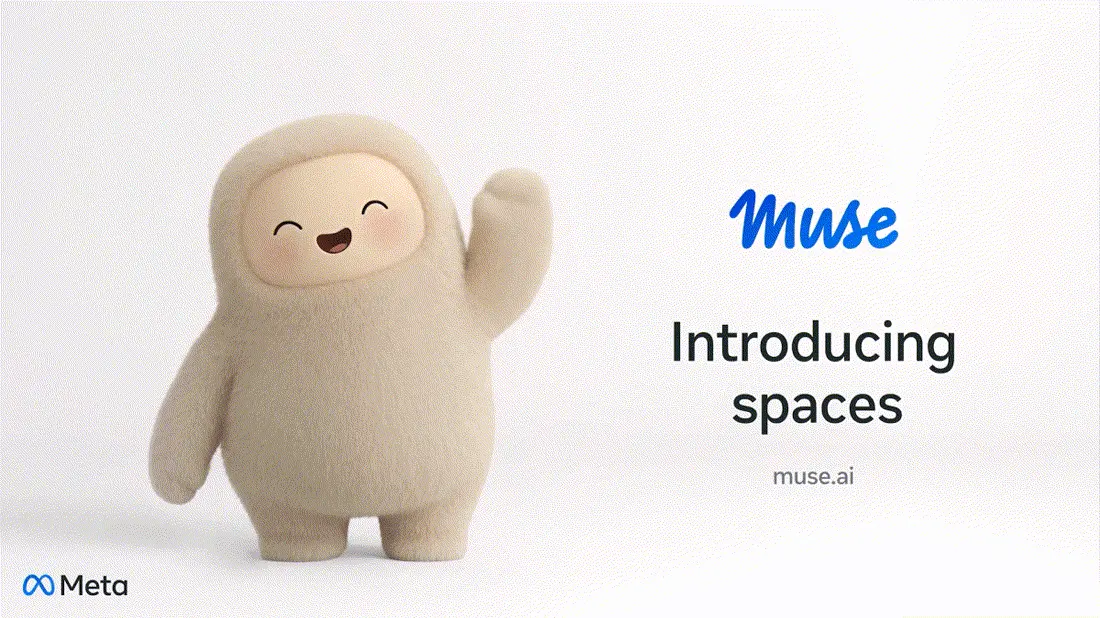
Meta's announcement, "Design the Muse App, Just for You" (November 6), says: "Starting today, spaces are available everywhere Muse is available." You describe an idea, such as a gift tracker, a daily word game or a DIY planning board, and Muse builds it as a space inside the app. You can keep asking Muse to change it, edit items directly, pin it to your sidebar or main tabs, schedule when it appears, and connect apps so it updates in the background. Sharing a space with other people isn't live yet; Meta says it's "exploring ways" to do it.
Spaces launched November 6. Image: Meta.
Muse Ember (November 9)
Meta's research blog introduced Muse Ember on November 9 as its "smallest, most efficient" model, and the first trained using Muse Wonder Full. The model ID is muse-ember-1.0. It's available in Muse Code and the Meta Model API, and Muse Ember, Muse Spark and Muse Wonder are also on Google Cloud and Oracle Cloud. It has a 1M-token context and up to 512K output tokens.
Muse Ember API prices per million tokens, by prompt size
Prompt size
Input
Cached input
Output
Up to 200K tokens
$0.10
$0.004
$0.50
Over 200K tokens
$0.30
$0.012
$1.50
The headline "$0.10/$0.50" is the rate for prompts up to 200K tokens; long prompts cost three times as much. Meta says its safety tests found Ember "remained below the framework's high-risk thresholds." We found no release of its weights; it's offered through the API. For what it's good for, see the model guide in story 01.
Why it mattersA phone-calling agent is the most "does something in the real world" feature Meta has shipped, and the open questions are the ones that matter in a real call: is it recorded, and does the other side know it's talking to an AI? Try it on a low-stakes call first. Spaces and Ember show the other half of Meta's plan: let anyone build on Muse, and let developers run it cheaply.
What has to get smaller before smart glasses go mainstream. EssilorLuxottica's recap of the EPIC "tipping point" meeting shows Meta, Google and Applied Materials around one table.#
Recap published · meeting held –, Milan (background)
The AI in smart glasses gets the headlines. The hard part is the glass: a lens that shows an image, holds a prescription, weighs almost nothing and can be made by the million. On November 12, EssilorLuxottica published a recap of the EPIC Technology Meeting on Photonics for AR: the Tipping Point, a two-day industry meeting it hosted at its Tortona office in Milan. It also posted photos on Instagram the same day. The recap came a month after the event: EPIC's own page dates the meeting October 13–14, with an optional October 12 visit to STMicroelectronics and the PoliFab lab.
Cover graphic for "EPIC Technology Meeting on Photonics for AR: the Tipping Point at EssilorLuxottica." Image: EPIC (the graphic carries a Fraunhofer HHI credit).
Who was in the room
EPIC, the European Photonics Industry Consortium, ran the meeting, which was fully booked. Its public agenda lists about thirty speakers. A sample, with the sessions they were in:
Selected speakers at the EPIC photonics for AR meeting, with affiliation and session
Session
Selected speakers (affiliation)
Opening, Oct 13
Brian O'Neill (EssilorLuxottica, Global Head of Advanced Technologies) · Raphaël Mermet-Lyaudoz (Yole Group, market overview)
1 · AR ecosystems
Jason Hartlove (Meta, VP and Head of XDO, keynote) · Jamie Murray Wells (Google, AR platform enablement, keynote) · Kayvan Mirza (Optinvent) · Satoshi Shiraga (Cellid)
Metrology
Instrument Systems · TechnoTeam · NLOptics · OptoFidelity (how you measure what a near-eye display actually shows)
2 · Prescription and adaptive optics
Mathieu Feuillade (EssilorLuxottica, Head of Augmented Vision Lab) · Franziska Zeller (ZEISS Extended Reality) · Rob Stevens (Oxford Optical Labs, CEO) · Bharath Rajagopalan (STMicroelectronics, keynote)
Edgar Auslander (Meta, moderator) · Christophe Peroz (Google) · David McLauchlan (Everysight) · T.J. Won (Meta) · Nathan Yang (TCL RayNeo)
The technical themes on the agenda: waveguides, microLED displays, laser beam scanning, nanoimprint and 3D printing, prescription and adaptive optics, and measuring near-eye image quality.
What EssilorLuxottica said
The recap has no figures, but it states the design rules plainly. In its own words: the consumer experience should be "at the centre," meaning "comfort, natural vision and attractive design"; AI should assist "at the right moment without becoming a distraction"; prescription compatibility is "a central design requirement rather than an additional feature"; AR should use "the existing ophthalmic value chain"; success depends on "higher production throughput, better yields, precise measurements and consistent image quality"; and "no single company or breakthrough technology can unlock AR adoption alone." The recap says Meta, Google and Applied Materials attended. It doesn't mention Ray-Ban Meta, Oakley Meta or the Meta Ray-Ban Display by name.
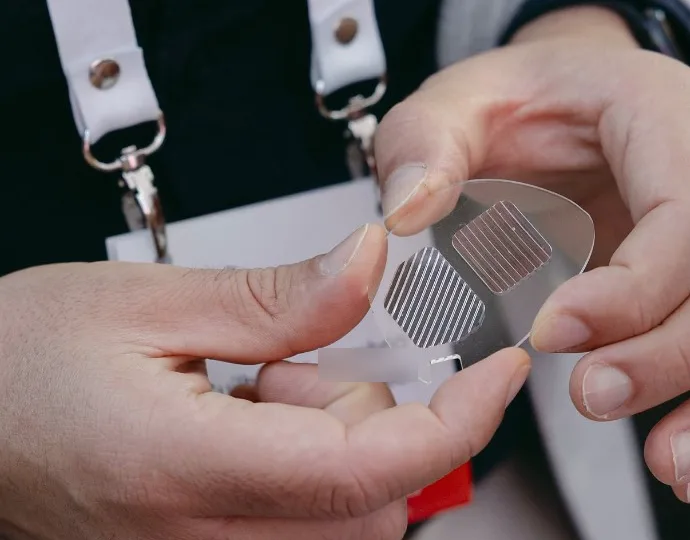
A photo in EssilorLuxottica's November 12 Instagram post: a thin transparent plate with two ribbed patches. The post doesn't say what it is; see below. Photo: EssilorLuxottica, cropped.
What is that clear plate?
The caption names no people and no product, so we can't say what the plate is.Inference, not fact: two ribbed rectangular patches on a thin, clear plate look like the in-coupling and out-coupling grating areas of a diffractive waveguide, the part of many AR glasses that carries an image from a tiny projector along the lens to your eye. That fits the meeting's waveguide and nanoimprint themes. A waveguide of this kind is why the manufacturing sessions (yield, throughput, measurement) mattered as much as the display talks.
The business context (background, from a summary)
An Investing.com summary of EssilorLuxottica's Q3 call (October 20) says wearables revenue grew 20% excluding material contributions from new products, Ray-Ban was up "strong double digit" in North America, and AI glasses turned negative in EMEA in the quarter. We read the summary, not the transcript.
Why it mattersSmart glasses compete on weight, battery, price and looking like normal glasses, and all four come back to the optics. This meeting put the lens makers, the display makers and the people building the glasses in one room, and the stated rule is that prescription lenses can't be an afterthought. That's a useful lens for any glasses launch you read about next: ask how the image reaches the eye, and whether it works with a prescription.
A $20 label printer and a calculator from high school. Two personal apps I built with Claude Fable 5.2 this week, and what surprised me.#
Personal story · written · Fable 5.2 launched (story 01)
Benchmarks tell you how a model scores. They don't tell you what it's like to hand it a small, annoying problem you've had for years. This week I gave Claude Fable 5.2 two of mine: a calculator I've missed since high school, and a cheap label printer whose own app was no use. Both worked, and both worked better than I expected. This is one person's experience, not a test, but it's the kind of job the bake-off in story 01 is for.
1. The calculator I always wanted
In high school I used one calculator so much that I never warmed to another: the Casio fx-911. I now have an app that looks and feels like it. The keys depress when you press them, there's haptic feedback, and each press clicks.
The part that stood out to me was the picture. I started from a rough image I found on Google, and Fable 5.2 turned it into a calculator face that's spot on: the solar-cell strip, the LCD with its faint "DEG" indicator, the cream function rows, the dark number keys, even the small mode table under the display and the "Formulas · Constants" tab at the bottom. It's the layout I remember.
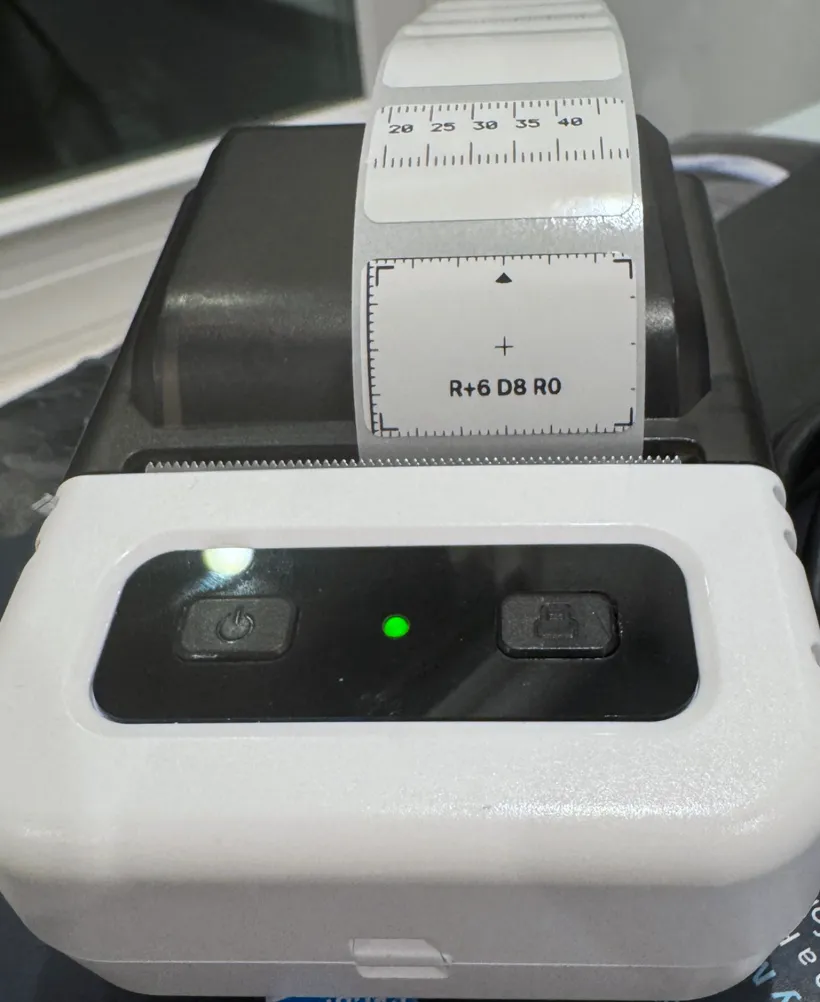
The calculator app, rebuilt from a rough image found online. Screenshot: the author.The $20 printer, printing a label from the custom app: ruler scale along the edges, corner marks, a centre cross and a line of text. Photo: the author.
2. The label printer with no manual
The second job was harder. I'd bought an undocumented printer for about $20 from Amazon. It prints fine, but its supporting app was bad, and there was nothing to read about how to talk to it. Fable 5.2 helped me build a custom app that works with it, including scanning with my phone to help create the new label. It also mapped out the label size, so labels render exactly where they should. The photo shows a result: edge rulers, corner marks, a centre cross and a line of text, all sitting inside the label.
Why it mattersThe headline number this week is a benchmark. The more useful change is smaller: jobs that were never worth a developer's weekend, such as a nicer calculator or a printer with a bad app, are now worth an afternoon. The work that used to make them not worth it, like guessing at an undocumented device and getting the pixels right, is what the model did.
If you want to try something like this
These two prompts are our suggestion, not the ones used above. Start small, check the result with your own eyes, and only point a model at hardware you own.
I'm attaching a rough picture of an old calculator I used to own.
Build me a calculator app that looks like it, with keys that press
down, a click sound and haptic feedback. Match the layout of the
picture exactly, and tell me which parts you had to guess.
I have a cheap label printer with no documentation and a bad app.
It's mine, and I'm connecting it over [Bluetooth / USB]. Work out how
to talk to it, test with one small label, and measure the label so
the printed area is exact. Then build me a simple app to design and
print labels. Show me each step before you print.
What to keep in mind. Fable 5.2 costs more per task than its price per token suggests (story 01), and Pro users' extra Fable usage ends November 16. A calculator that copies a real product's look is fine for your own use; if you ever share or sell one, check the maker's trademark and design rules first.
18
18 · Cincinnati & OhioAll users
Now the lawyers: does a data-center ban stop one that's already being built? Plus a lame-duck statehouse and a full December calendar.#
– · follow-up to Issue 31
Issue 31 covered the November 3 votes: Trenton's Issue 17 passed with 79.7%, Piqua and other Ohio cities passed bans, and Wilmington reversed its rezoning. This week the question became who the bans actually bind.
Trenton residents move against the AWS campus under construction
Trenton (November 9). Five residents sent the city attorney a letter asking him to seek a court order revoking the zoning certificate issued in December 2025 for the 250 MW data-center campus Prologis is building on 141 acres for AWS. They argue that Issue 17's definition of "construction" covers work already under way. Prologis says, "The result does not affect our project." At council's first meeting after the vote (November 5), members met in closed session about AWS and another project. Mayor Ryan Perry: "Sometimes you win, and sometimes you learn."
Piqua. Voters passed a 25 MW ban 66.7%–33.3%, and the city says "it is unclear at this time if and how this Charter amendment may affect the Meta data center project," a roughly 607-acre site with more than $1 billion of planned investment. A land-use attorney told the Dayton Daily News that permits issued and work started before a new rule strengthen a developer's case, and pointed to the Ohio Supreme Court's October Lordstown ruling, which went against a developer who hadn't finished its permit application.
The statehouse (November 9–10). Lawmakers returned November 9 for a lame-duck session that runs to December 17; bills not passed die December 31. HB 646, which would create a data-center study commission, could be revived. An Ohio Chamber of Commerce foundation report (November 10) credits data centers with more than $9 billion of Ohio GDP and about 69,600 jobs, and says the state gave up about $1.57 billion in sales tax through its exemption. Chamber CEO Steve Stivers said voters "basically said they don't like the current business model of data centers."
Governor-elect Amy Acton (November 6) repeated her plan for a "conditional moratorium" on CBS Mornings: "We're protecting our air and water." No bill text or transition plan has been published.
Cincinnati: the city's temporary data-center zoning overlay (IDCO #89) runs until February 11, 2027, with nothing new this week.
Also local
November 12: The University of Cincinnati made its Center for Humanities and Technology (CHaT) official, led by philosophy professor André Curtis-Trudel and partly funded by a $500,000 NEH award. It plans a spring 2027 conference on AI and explainability. "Humanities scholars help us understand how AI affects people, culture, and society," said Provost Rudy Buchheit.
November 12: UC's campus chatbot BearcatsGPT adds a no-setup default chat and Projects, workspaces whose files and instructions carry into every chat, for all students, faculty and staff from the week of November 16.
November 10:CincyAI for Humans published its recap of the November 3 meetup, where breakout groups collected wish lists for 2027. It also launched CincyAI Champions, a paid membership ($25 a month or $250 a year, 30-day free trial) with "Human Huddles" peer groups from AI 101 to Women in AI and AI for Nonprofits.
November 11: The Cincinnati AI Catalyst x Innovarist.ai 2026 Healthcare Summit took place at the University of Cincinnati, and Local 12 (WKRC) covered it in "AI in healthcare summit held at University of Cincinnati" (Rebecca Smith, 5:57 PM). The report centers on "human-centered AI": whether it can make conditions easier to diagnose and care cheaper. It cites a Marsh McLennan survey that employer health-benefit cost per employee is expected to rise 8% next year, the biggest increase since 2003. Summit organizer Jamison DeAngelis hopes AI can make health systems more efficient. UC AI Bio Lab director Kelly Cohen (Local 12 spells the surname "Kohen") says AI can help tailor treatment to individual needs. Radiologist Alex Tobin says AI can "look at every pixel of a picture," and Cortex AI CEO Kyle Frye says it could help decide what level of care a patient needs next. A second part, on using AI to detect and fight cancer, was due on Local 12 on Thursday evening. The AI Bio Lab's own post (LinkedIn, November 11–12) said Cohen was expected to talk about why trustworthiness matters in mission-critical systems; the Local 12 report doesn't cover that point. It also noted that PhD student John Cavanaugh spoke on a morning panel and PhD student Haidar Bin Hamid had a table for Flipp Health, a healthcare app in beta. (Cohen is also on the Xavier AI and Ethics panel on November 19, below.)
No 2026 recaps yet of Great Lakes AI Week (November 10–12) or The Circuit's Best of Tech Awards (November 12).
The Cincinnati AI in Healthcare 2026 Summit, as shown in Local 12's report (November 11). Sponsors on the sign: Landi Industries, Nexigen and The Health Collaborative. Photo: WKRC / Local 12.UC AI Bio Lab leader Kelly Cohen with a Local 12 reporter at the Healthcare Summit (November 11). Photo: AI Bio Lab on LinkedIn.UC's new Center for Humanities and Technology studies AI's effect on people and culture (November 12). Image: University of Cincinnati.
Upcoming events
Re-verified from Issue 31 on November 13: every row from November 17 onward is still on, with none cancelled. Corrections: the Ohio AI Summit costs $150–$242, Taste of IT is at the Sinclair Conference Center, and the CincyAI December 1 lab tour needs its own signup. Six events are new.
Upcoming AI events in Cincinnati, Dayton, Columbus and online, November 16 to December 10, 2026
Why it mattersOhio voted no on data centers last week; this week showed how much of that "no" holds. The projects people were most worried about already have permits and bulldozers, so the next fights are in court and at the statehouse, before a new governor arrives in January. For learning, Xavier's free ethics panel (register by Tuesday) and the CincyPy agent hackathon are both next week.
Thirteen tips we haven't run before. Each one uses something shipped or documented this week.#
Checked against every past AI Weekly issue's tips and our past roundups; none repeat. Tips 1 to 7 are for everyone, and 8 to 13 for developers and IT. If you only do one, do tip 8.
Tip 1 · Claude Sheets and Whiteboards beta · Nov 10 · all paid plans
Ask Claude for a real spreadsheet, or put a messy brainstorm on a whiteboard.
Claude now builds spreadsheets with tabs, formulas and drop-downs you can export to Excel, and whiteboards that group notes by theme and turn into a doc or deck. On Enterprise, an admin turns them on under Organization settings › Artifacts.
Try this: "Build me a Claude Sheet to track our Q1 hiring budget: one tab per department, columns for role, start month, salary, and a drop-down for status (open / offer / filled). Add a summary tab with totals by department and month."
Tip 2 · Anthropic's Opus 5.5 guidance · Nov 12
Delete "think hard" from your prompts, and ask for the finished thing.
Thinking is always on in Opus 5.5, and Anthropic found that removing phrases like "think hard" made replies start sooner without a clear drop in quality. In your first message, describe the goal and the finished output (a deck, not an outline), and say when Claude should stop and ask. If the answer falls short, raise the effort setting before you switch models.
Try this: "Goal: figure out why sign-ups fell in Q3. Leadership's three theories are in the attached note; the data is in the attached CSV. Test each theory against the data and give me a finished six-slide deck saying which held up. Stop and ask me if the data can't answer a theory."
Tip 3 · Dylan Davis · Nov 11
Make the AI interview you before it writes anything.
Instead of writing a long prompt, give the goal and let the AI ask one question at a time. Davis suggests 1–3 questions for simple jobs and 5–8 for medium ones. After a test run, have it fold your corrections into the saved instructions.
Try this: "Before you do anything, interview me. Ask me one question at a time. Let each answer shape your next question. Stop when you have what you need, and cap it at around 8 questions."
Tip 4 · Jeff Su · Nov 10
Have the AI repeat your intent back before it starts.
Su's "Intent Check": paste rough notes and have the AI restate what you're really after and propose a plan you approve. It catches misunderstandings before the work starts.
Try this: "Review all attached materials and the full context of my message, even if the information is rough, fragmented, or unfiltered. Repeat my underlying intent back to me and propose a plan of action for my review. Keep the plan proportionate to the goal."
Tip 5 · Google Sheets · Nov 11 · business plans, Google AI Pro/Ultra
Share a Gemini dashboard without sharing the spreadsheet.
Ask Gemini in Sheets to build a canvas (an interactive mini-app), then click the publish icon › Publish canvas to get a read-only link. Choose whether it updates automatically when the data changes. Rolling out from November 11; Scheduled Release domains from December 2.
Try this (in Gemini in Sheets): "Build a canvas dashboard of this campaign data: spend versus sign-ups by week, with a filter by channel."
Tip 6 · FBI FaceStealer alert · Nov 12
Never let a video call "fix your audio."
If someone on a Zoom or Teams call says they can't hear you and sends a link, script or "update," don't run it. Join meetings through the official app with the meeting ID, not a web link; confirm unexpected invites by text or phone; and call back on a number you already have before acting on any urgent money request from a "CEO" or "lawyer." Report attempts at IC3.gov with the keyword "FaceStealer" (story 10).
Tip 7 · Workspace Studio · Nov 9 · Google Workspace
Make a Google Workspace flow wait until Monday morning.
Add a Wait until step to a Workspace Studio flow to pause it until a set time (say, Monday at 8 AM) or for up to 14 days. Paused flows show in the Activity tab.
Try this (at studio.workspace.google.com): "When a customer form response arrives, draft a thank-you email, then wait 3 days; if they haven't replied, send me a reminder in Chat."
Tip 8 · wfx campaign · Endor Labs, Aikido, SafeDep · Nov 12 · Developers and IT
Check whether wfx touched your repositories.
Run these from a clone of each repository you care about (the first one covers a whole organization; swap in your org or user name). Anything that matches means: rotate every secret that repository's workflows could reach, including AI keys, and follow the clean-up steps in story 05. Nothing found? Make GITHUB_TOKEN read-only by default under Settings › Actions › General › Workflow permissions while you're there.
On github.com, the search org:YOUR-ORG is:pr head:wfx-docs created:>=2026-11-10 does step 1 without the CLI. chore/ branches are common, so check what's on them before you panic.
Tip 9 · Claude Code 2.1.323 · Nov 12 · Apiiro research
Check your repos for secrets Claude Code's "don't ask again" saved.
Update first, then look for the file in git and in its history. Rotate anything you find before cleaning up, then remove secret-bearing rules with /permissions (story 07).
npm i -g @anthropic-ai/claude-code@latest            # 2.1.323 or later
git ls-files .claude/settings.local.json             # is it tracked?
git log --all -p -- .claude/ | grep -nE 'PGPASSWORD=|sshpass -p|mysql .*-p'
git rm --cached .claude/settings.local.json && echo ".claude/settings.local.json" >> .gitignore
Tip 10 · Claude Code 2.1.319 · Nov 6
Stop unattended Claude Code runs from hanging on a permission prompt.
permissions.denyInsteadOfPrompting denies any tool call that would wait for a prompt, and the turn carries on. Allowed calls still run. It only works in user or managed settings (or --settings), so a repository can't switch it on for you. In ~/.claude/settings.json:
Ask Claude Code to find where your Claude app makes people wait, and reopen a finished subagent.
/claude-api latency-optimize finds the slow spots in your Claude API code and tries faster settings against your eval. /tasks now has an "Earlier in this session" row, so you can message a subagent that already finished, even after a restart.
claude update
# then, inside a session in your project:
/claude-api latency-optimize
/tasks
Tip 12 · GitHub Copilot Memory (GA) and Dreaming (preview) · Oct 28 · paid plans
Read what Copilot remembers about you, and let it propose fixes to your instructions.
Copilot Memory now carries your preferences and repository conventions across sessions. Open your Copilot settings, read the saved memories, and delete anything wrong or out of date: a stale memory steers every later session. If you want Copilot to tidy them for you, turn on Dreaming (personal curation in Copilot settings, or per repository in repository settings; organizations need an admin policy). Its changes to instructions and skills arrive as pull requests, so review them like any other code. Dream runs use AI credits (story 06).
Try this (in a Copilot chat in your repo): "List the conventions you've remembered about this repository and where each came from. Flag any that contradict our .github/copilot-instructions.md."
Tip 13 · GitHub Spec Kit v1.4.0 · Nov 10 · any supported coding agent
Make your coding agent write the spec before it writes the code.
Install Spec Kit, start a project, open your agent in that folder and run the commands one at a time, reading each result before the next. Per the GitHub README (Python 3.11+ and uv needed; swap copilot for your agent):
uv tool install specify-cli
specify init my-project --integration copilot
cd my-project
# then, in your agent's chat, once per project:
/speckit-constitution
# and for each feature:
/speckit-specify
/speckit-plan
/speckit-tasks
/speckit-implement
/speckit-converge
Try this (after /speckit-specify): "Build a page that shows our open support tickets by age. Users: the store-support team. Done means: sorted oldest first, loads in under two seconds, no ticket text is stored outside the ticket system."
Skip speckit.org's install line: it still shows the older command (story 06). The full guide adds existing repos, extensions, upgrades and a security clean-up plan.
Also new and worth a look: Using a non-Claude model in Claude Code? Since 2.1.323 it assumes a 1M-token context; export CLAUDE_CODE_DISABLE_1M_CONTEXT=1 keeps 200K. In GitHub Copilot CLI, /code hands the session to VS Code 1.146. codex exec --trust (Codex CLI 0.169.0) now has to be said out loud before project MCP servers run. Pin your MCP servers to a version (uvx pkg@1.2.3, not uvx pkg), per Corelight. And npx modern-web-guidance@latest install teaches your coding agent current web APIs.
Google Workspace Updates (November 9 and 11) (tips 5 and 7) · FBI FLASH AC-111226-MS (November 12) and Help Net Security (November 9) (tip 6)
Endor Labs, Aikido and SafeDep (November 12) (tip 8)
Claude Code CHANGELOG 2.1.319 and 2.1.323 (November 6 and 12) and the settings reference; Apiiro via DEV Community (November 7) (tips 9–11)
GitHub Changelog, "GitHub intelligence puts your code, context and history to work" (October 28) (tip 12)
github/spec-kit README and releases (November 10) (tip 13)
VS Code 1.146 release notes (November 11); Codex CLI 0.169.0 (November 13); Cyber Security News on Corelight (November 11); Chrome for Developers (November 10) (also new)
Also worth a mention
November 8: Bloomberg's Mark Gurman reports Apple CEO John Ternus is pushing for an agentic Siri "as soon as next year." Apple hasn't confirmed it. (9to5Mac)
November 9: Anthropic and Diode Computers had Fable 5.2 design three working gadgets (a speakerphone, a voice-assistant hub and a handheld virtual pet) that were built straight from Claude's files; they're prototypes, not certified products. (Anthropic)
November 6: Anthropic's engineering post on agent memory: Opus 5.5 scored 0.655 without memory and 0.838 with it on CL-Bench; the advice is to describe what memory is for and keep always-loaded context small. (Anthropic)
November 9: Amazon says replacing Sonnet 4.6 with a small Strands Decider model for ticket labelling cut cost per ticket about 44x (self-reported; no accuracy figure given). (Strands Agents)
November 9:VulnCheck counts 442 CVEs credited to Anthropic's Glasswing bug-hunting program, about 0.5% of 2026's CVEs. (VulnCheck)
November 6–9: A quiet week for open weights: Nous Research's Arete-27B (Apache 2.0) cut propaganda in answers from 22% to 0.9% on its own test, and Zyphra's ZONOS3-Mini is an open text-to-speech model covering 43 languages that runs in a browser. (Hugging Face · Hugging Face)
November 6–8: Eminem's publisher sued Suno over 269 songs (seeking more than $40M), and Elvis Presley's rights holders filed a separate suit. (The Source · Engadget)
November 13: Australia's bank regulator APRA named frontier AI from Anthropic and OpenAI as a top risk to the financial system and plans AI stress tests next year. (ABC News)
November 6–7: Microsoft's Copilot Cowork added a Planner plugin and OneNote support, updating notebook pages with your approval. (Microsoft Learn)
FAQ
What is Claude Fable 5.2 and how much does it cost?
Claude Fable 5.2 is Anthropic's top AI model, released November 9, 2026. On the API it costs $8 per million input tokens and $40 per million output tokens, down from $10 and $50 for Fable 5.1, and fast mode costs $16/$80 for up to 2.5 times faster output. It has a 1-million-token context window, and Artificial Analysis ranks it first on its intelligence index with a score of 65. Claude Pro and standard Team seats can use it for up to half their weekly limits through November 16, 2026; Max, Ultra and premium seats get one to three free Fable limit resets that last until March 8, 2027.
What is the wfx GitHub campaign, and how do I check if I'm affected?
wfx (also called "wfx-loot" or "WFX Phantom") is a campaign that began on November 10, 2026, in which an attacker used stolen GitHub tokens from about 4,837 accounts to open probe pull requests titled "docs: dependency audit notes" from a branch named wfx-docs, then pushed a script that runs in GitHub Actions and steals secrets, cloud credentials and AI keys such as OpenAI, Anthropic and Gemini keys. Aikido says the stealer ran in at least 1,806 repositories, and SafeDep counted 8,093 public repositories with malicious commits. It doesn't exploit a GitHub Actions bug. To check, search your organization for that pull request title, look for commits named "ci: refresh build cache" or "chore: add ci helper," branches named wfx-docs, and gaps in workflow run numbers. If you find any, rotate every secret those workflows could reach and remove any cloud credentials or trust policies the attacker added.
When is the Anthropic IPO, and what is the ticker?
Anthropic launched its IPO roadshow on November 10, 2026, offering 825 million Class A shares at $70 to $78 each on the Nasdaq under the ticker ANT. CNBC reports pricing is set for November 18 and trading for November 19, 2026, which would raise up to $64.35 billion and value the company at up to $1.405 trillion fully diluted. AMD, Broadcom, Google, Micron, Microsoft, NVIDIA and TSMC agreed to buy $26 billion of non-voting shares at the IPO price.
Why did Jensen Huang resign from Nvidia?
Nvidia announced on November 12, 2026 that Jensen Huang had resigned as president, CEO and board member, effective immediately, without giving a reason. His resignation followed a week of reports about extramarital relationships, including one with a woman US officials reportedly believe is a Chinese intelligence asset, and an independent board investigation opened November 8. Huang has denied compromising national security or Nvidia's secrets. CFO Colette Kress is interim CEO, Harvey C. Jones is Nvidia's first board chair, and Nvidia still plans to report earnings on November 17, 2026.
What is GitHub Copilot Memory, and what is Dreaming?
Copilot Memory, generally available on paid GitHub Copilot plans since October 28, 2026, lets Copilot remember your preferences and a repository's conventions across sessions and tools; you can view and delete saved memories in Copilot settings. Dreaming, in public preview since the same day, is an opt-in feature that reviews past sessions and review feedback to tidy those memories and proposes changes to repository instructions and skills as pull requests for a person to review. Dream runs use AI credits.
Can Meta's Muse make phone calls for me?
Yes, for some people. On November 12, 2026, Meta announced that its Muse AI agent can place phone calls to US businesses on your behalf, using an AI-generated voice, for paid US subscribers starting with the $19.99-a-month plan (which includes 500 million Muse tokens a week). Examples include calling an insurance provider, scheduling a DMV appointment or booking a restaurant. PCMag calls the results hit-or-miss, and some staff hang up when they realize it's an AI. Reports don't say whether calls are recorded or whether the business is told it's an AI.
What is Spec Kit?
Spec Kit is GitHub's open-source, MIT-licensed toolkit for spec-driven development: it has an AI coding agent write a specification, a plan and a task list, which a person reviews, before the agent writes code. You install it with uv tool install specify-cli, start a project with specify init, and run commands such as /speckit-specify, /speckit-plan, /speckit-tasks and /speckit-implement in your agent's chat. Its latest release at publication is v1.4.0, from November 10, 2026.
What is Claude Meetings?
Claude Meetings is a beta feature, launched November 12, 2026, that lets Claude join Google Meet calls as a visible participant on Claude Team and Enterprise plans. You can ask it questions during the call, and afterward it provides a summary, action items and a transcript; it doesn't keep audio. By default it stays out of meetings with external guests. Notes, transcripts and in-call answers are free during the beta, and support for other meeting platforms is "coming soon."
What is Gemini 4 Hydrogen?
Gemini 4 Hydrogen is Google's fast, low-cost AI model, released November 12, 2026. It now powers Google Search for all users and is available in the Gemini app, the Gemini API, Google Sheets and Antigravity. On the API it costs $1.50 per million input tokens and $7.50 per million output tokens across a 1-million-token context. Google says it's 2.5 times faster than Gemini 3.8 Flash with more than five times fewer fabricated claims (self-reported).
What is ChatGPT Wallet?
ChatGPT Wallet, launched November 13, 2026, lets OpenAI's "dots" agents make purchases for you. It was built with American Express, Mastercard and Visa: you add a card once and approve each purchase, and the card network issues a single-use payment token so the agent never sees your card number. At launch it's limited to US ChatGPT Pro subscribers aged 18 and over, and OpenAI takes no cut of transactions.
When is the next CincyAI for Humans meetup?
The next CincyAI for Humans meetup, the last of 2026, is Tuesday, December 1, from 3 to 5 PM at the University of Cincinnati's Digital Futures building, Room 140, 3080 Exploration Ave. It's free with RSVP on Eventbrite, and a 2:30 PM lab tour for the first 15 people needs a separate signup. Before then, Xavier University's free AI and Ethics panel is Thursday, November 19, from 6 to 8 PM (register by November 17), and the CincyPy agent hackathon is Wednesday, November 18.
Quick stats
Every figure is sourced in its story. Vendor benchmarks and company figures are self-reported.
Metric
Value
Claude Fable 5.2 price / fast mode, per M tokens (Anthropic, Nov 9)
$8/$40 / $16/$80
Fable 5.2 Artificial Analysis Intelligence Index (Latent Space, Nov 9–10)
65 (#1)
Fable 5.2 fewer blocked queries vs 5.1 (Anthropic, Nov 9, self-reported)
~55%
Fable 5.2 cost per task, SemiAnalysis GDPx (Latent Space, Nov 9–10)
$88.15 (was $67.16)
Gemini 4 Hydrogen price, per M tokens (Google, Nov 12)
$1.50/$7.50
Gemini 4 Carbon price now / after Nov 30 (Google, Nov 10)
$2/$10 / $4/$20
Muse Ember price, per M tokens, up to 200K / over 200K (Meta, Nov 9)
$0.10/$0.50 / $0.30/$1.50
Muse phone-call plan / weekly tokens (TechCrunch, PCMag, Nov 12–13)
$19.99 a month / 500M
Spec Kit latest release / stars (GitHub, Nov 10–13)
v1.4.0 / ~150,000
Anthropic IPO shares / price range (Anthropic, SEC, Nov 10)
825M / $70–78
Anthropic maximum raise / valuation (CNBC, Nov 10)
$64.35B / $1.405T
Anchor investors' share purchase (S-1/A No. 2, Nov 10)
$26B
Anthropic Q3 operating loss, settled (S-1/A No. 2, Nov 10)
$567M
Nvidia drop at open / close, Nov 12 (CNBC)
−13% / −4.3%
Nvidia value lost, previous Friday to Nov 11 close (CNBC)
$740B+
wfx: hijacked accounts / repositories probed (Aikido, Nov 12)
4,837 / 61,764
wfx: repositories where the stealer ran (Aikido) / with malicious commits (SafeDep)
1,806+ / 8,093
GitHub Rubicon: concurrent agents / pushes per second on one repository (GitHub, Nov 5)
5,000 / 7,200
Public Claude Code settings files with secrets / secrets missed by both scanners (Apiiro via DEV, Nov 7, self-reported)
1,122 / 215
Customer projects breached via Mittwald's MCP server (Mittwald, Nov 7)
56
OpenAI first close / valuation (Bloomberg via SiliconANGLE, Nov 6)
~$11B / $1.25T
OpenAI Q3 revenue (Bloomberg/WSJ via Crypto Briefing, Nov 10)
~$10B
Autonomous AI attack operations / organizations breached (Unit 42, Nov 12)
25 / 10
FaceStealer theft / victim videos seized (DOJ, Nov 12)
$400M+ / 900+
Deepfake-CEO fraud indictment (Help Net Security, Nov 9)
$129M
Senate vote to take up permitting bill (AP, Nov 9)
73–25
NY RAISE Act incident-report deadline / fine (TechCrunch, Nov 10)
72 hours / up to $1M ($3M repeat)
Cisco Q1 revenue / growth (Cisco, Nov 12)
$18.5B / +24%
CoreWeave Q3 revenue / backlog (CoreWeave, SiliconANGLE, Nov 10)
$3.66B / $132.5B
Agent traffic share, Meta + OpenAI / reaching checkout (HUMAN via PPC Land, Nov 9–13)
~89% / 1.9%
Alexa for Shopping users, past 12 months (Amazon, Nov 6)
400M+
Trenton data-center campus targeted by residents (Dayton Daily News, Nov 12)
250 MW
Ohio data centers' GDP contribution / sales tax forgone (Ohio Chamber via Statehouse News, Nov 10)